

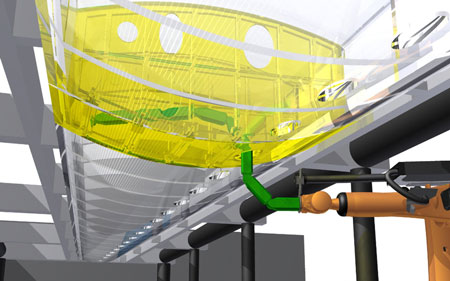
 The robot winds its way through the narrow openings inside the airfoil like a snake. Its articulated joints are so flexible that they can reach the furthermost regions of the workspace. (Image: Fraunhofer IWU)
The volume of air traffic has soared in the past few decades, and aircraft manufacturer Airbus expects to see this figure triple by 2030. On a single day, more than 1,300 take-offs and landings are handled by the flight tower at Frankfurt’s international airport. This represents no less than 155,000 passengers who pass through this airport each day. To provide sufficient planes to cover this need for air transportation capacity, aircraft manufacturers will have to modernize their production processes.
Until now, aircraft assembly has involved a high proportion of manual processes, which limits production output. These processes must be automated to increase the rate of production. In certain cases this can be achieved easily, but wing…
View original post 580 more words


