
3,200 words
Edited by Pam Weintraub
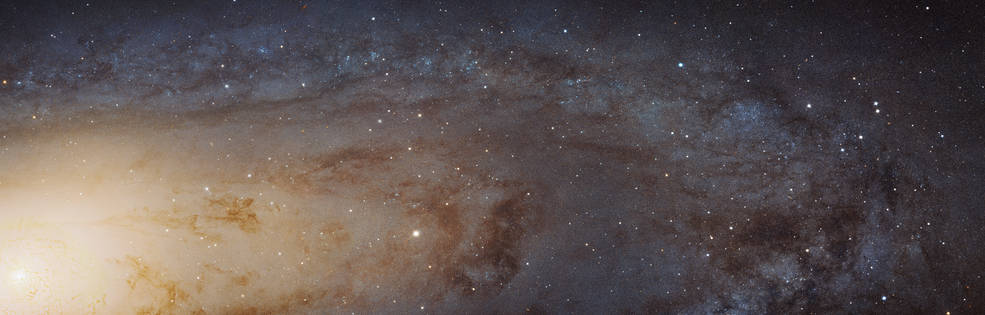
In 1969, the American astronomer Vera Rubin puzzled over her observations of the sprawling Andromeda Galaxy, the Milky Way’s biggest neighbour. As she mapped out the rotating spiral arms of the stars through spectra that she and colleagues had carefully measured at the Kitt Peak National Observatory and the Lowell Observatory, both in Arizona, she noticed something strange: the stars in the galaxy’s outskirts seemed to be orbiting far too fast. So fast that she’d expect them to escape Andromeda and fling out into the heavens beyond. Yet the whirling stars stayed in place.
Rubin’s research, which she expanded to dozens of other spiral galaxies, led to a dramatic dilemma: either there was much more matter out there, dark and hidden from sight but holding the galaxies together with its gravitational pull, or gravity somehow works very differently on the vast scale of a galaxy than scientists previously thought.
Her influential discovery never earned Rubin a Nobel Prize, but scientists began looking for signs of dark matter everywhere, around stars and gas clouds and among the largest structures in the galaxies in the Universe. By the 1970s, the astrophysicist Simon White at the University of Cambridge argued that he could explain the conglomerations of galaxies with a model in which most of the Universe’s matter is dark, far outnumbering all the atoms in all the stars in the sky. In the following decade, White and others built on that research by simulating the dynamics of hypothetical dark matter particles on the not-so-userfriendly computers of the day.
But despite those advances, over the past half century, no one has ever directly detected a single particle of dark matter. Over and over again, dark matter has resisted being pinned down, like a fleeting shadow in the woods. Every time physicists have searched for dark matter particles with powerful and sensitive experiments in abandoned mines and in Antarctica, and whenever they’ve tried to produce them in particle accelerators, they’ve come back empty-handed. For a while, physicists hoped to find a theoretical type of matter called weakly interacting massive particles (WIMPs), but searches for them have repeatedly turned up nothing.
With the WIMP candidacy all but dead, dark matter is apparently the most ubiquitous thing physicists have never found. And as long as it’s not found, it’s still possible that there is no dark matter at all. An alternative remains: instead of huge amounts of hidden matter, some mysterious aspect of gravity could be warping the cosmos instead.
The notion that gravity behaves differently on large scales has been relegated to the fringe since Rubin’s and White’s heyday in the 1970s. But now it’s time to consider the possibility. Scientists and research teams should be encouraged to pursue alternatives to dark matter. Conferences and grant committees should allow physicists to hash out these theories and design new experiments. Regardless of who turns out to be right, such research on alternatives ultimately helps to crystallise the demarcation between what we don’t know and what we do. It will encourage challenging questions, spur reproducibility studies, poke holes in weak spots of the theories, and inspire new thinking about the way forward. And it will force us to decide what kinds of evidence we need to believe in something we cannot see.
We have been here before. In the early 1980s, the Israeli physicist Mordehai ‘Moti’ Milgrom questioned the increasingly popular dark matter narrative. While working at an institute south of Tel Aviv, he studied measurements by Rubin and others, and proposed that physicists hadn’t been missing matter; instead, they’d been wrongly assuming that they completely understood how gravity works. Since the outer stars and gas clouds orbit galaxies much faster than expected, it makes more sense to try to correct the standard view of gravity than to conjure an entirely new kind of matter.
Milgrom proposed that Isaac Newton’s second law of motion (describing how the gravitational force acting on an object varies with its acceleration and mass) changes ever so slightly, depending on the object’s acceleration. Planets such as Neptune or Uranus orbiting our sun, or stars orbiting close to the centre of our galaxy, don’t feel the difference. But far in the outlying areas of the Milky Way, stars would feel a smaller gravitational force than previously thought from the bulk of matter in the galaxy; adjusting Newton’s law could provide an explanation for the speeds Rubin measured, without needing to invoke dark matter.
Developing the paradigm of a dark-matter-less universe became Milgrom’s life project. At first, he worked mostly in isolation on his proto-theory, which he called Modified Newtonian Dynamics (MOND). ‘For more than a few years, I was the only one,’ he says. But slowly other scientists circled round.
He and a handful of others first focused on rotating galaxies, where MOND accurately describes what Rubin observed at least as well as dark matter theories do. Milgrom and colleagues then expanded the scope of their research, predicting a relationship between how fast the outside of a galaxy rotates and the galaxy’s total mass, minus any dark matter. The astronomers R Brent Tully and J Richard Fisher measured and confirmed just such a trend, which many dark matter models have struggled to explain.
When space-time gets curved in a particular way it creates the illusion of dark matter
Despite these successes, Milgrom’s modification of Newton’s second law remained just an approximation, causing his ideas to fall short of requirements for a full-fledged theory. That began to change when Milgrom’s colleague Jacob Bekenstein at the Hebrew University of Jerusalem extendedMOND to show it could be consistent with Albert Einstein’s theory of general relativity, which predicts that gravity has the power to bend light rays, an idea proven just over a century ago, during a solar eclipse in 1919, and today known as ‘gravitational lensing’.
Around the same time, the American astronomer Edwin Hubble noticed that his colleagues had considered that close groups of gas clouds were actually far more distant galaxies. Building on Hubble’s discovery, other astronomers demonstrated the existence of larger cosmic structures now known as galaxy clusters, which have the power to act like powerful lenses, strongly bending light rays. Using formulas based on predictions by Einstein, it’s possible to infer the mass of a cosmic lens. Based on this mathematics, many physicists used gravitational lensing as an argument for the existence of dark matter. But Bekenstein showed that general relativity and MOND could also explain at least some lensing measurements that have been made.
Even so, these ideas were only partly formed. Indeed, Milgrom and Bekenstein still didn’t know what in physics could create a modified law of gravity.
MOND lacked much of a foundation until a few years ago, when the Dutch physicist Erik Verlinde began developing a theory known as ‘emergent gravity’ to explain why gravity was altered. In Verlinde’s view, gravity, including MOND, emerges as a kind of thermodynamic effect, related to increasing entropy or disorder. His ideas build on quantum physics as well, viewing space-time and the matter within it as originating from an interconnected array of quantum bits. When space-time gets curved, it produces gravity, and if it’s curved in a particular way, it creates the illusion of dark matter.[…]
Continue reading: https://aeon.co/essays/why-its-time-to-take-alternatives-to-dark-matter-seriously

 msamba