
An international consortium of scientists has analyzed, as part of a vast program of cosmological surveys, several million galaxies and quasars, thus retracing a more continuous history of the Universe and offering a better understanding of the mechanisms of its expansion. The latest 6 year-long survey called eBOSS was initiated, and led in part, by EPFL astrophysicist Jean-Paul Kneib.

It is the largest 3D map of the Universe produced to date. It is the fruit of a twenty-year collaboration of several hundred scientists from around thirty different institutions around the world, all united within the “Sloan Digital Sky Survey” (SDSS), with data collected from an optical telescope dedicated to the project located in New Mexico, in the United States.
Released today in the form of more than twenty scientific publications, this latest mapping of the night sky is an unprecedented and ambitious astronomical survey from 2014 until 2020. Resulting from the analysis of several millions of galaxies and quasars, this latest survey builds upon existing data as early as 1998 to fill certain gaps in cosmological history and to improve our understanding of the mechanisms underlying the expansion of the Universe.
EPFL (Ecole polytechnique fédérale de Lausanne) is directly involved in this important project. This latest cosmological survey of the SDSS, called “The extended Baryon Oscillation Spectroscopic Survey” (eBOSS), includes more than 100 astrophysicists, of which several are researchers from EPFL. Jean-Paul Kneib, who heads EPFL’s Astrophysics Laboratory (LASTRO), initiated the eBOSS survey and was its principal investigator (PI) for several years.
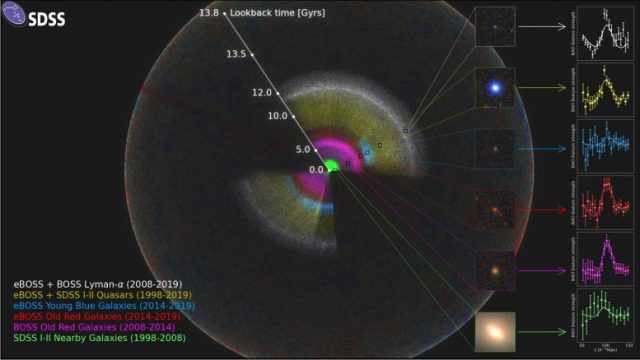
“In 2012, I launched the eBOSS project with the idea of producing the most complete 3D map of the Universe throughout the lifetime of the Universe, implementing for the first time celestial objects that indicate the distribution of matter in the distant Universe, galaxies that actively form stars and quasars,” reports Jean-Paul Kneib. “It is a great pleasure to see the culmination of this work today. ”[…]
More: Astrophysicists Construct Most Complete 3D Map of the Universe, Fill Gaps in Cosmological History

 msamba