
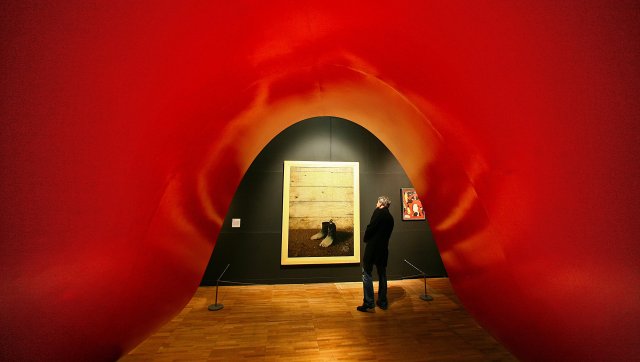
At the Surreal Things exhibition at the V&A Museum on 27 March 2007. Photo by Peter Macdiarmid/Getty
In 1999, the US broadcaster ABC commissioned a pilot for a new TV series set in Los Angeles. It starts with a brunette emerging from a car crash. There’s $125,000 in her bag, but she has no memory of who she is or where she was going.
Anyone hoping for a standard story arc to unfold at this point would have been disappointed. Many scenes are left unresolved and seem disconnected. And there are eerie, fantastical elements, such as the appearances of a dwarf with oversized prosthetic arms and a tiny head, and an enigmatic cowboy who is totally at odds with the film’s setting in modern Hollywood.
Although the network dropped the series before it aired, the director turned the pilot into a feature film that enjoyed a worldwide release. He had not resolved all its incongruities, however, with one critic of the film complaining that ‘nothing makes any sense … There’s no purpose or logic to events.’ Salon spent a large portion of their review asking: ‘What the fuck is going on in this movie?’
Yet today, David Lynch’s Mulholland Drive (2001) is considered one of the best films of the 21st century (appearing at the top of a poll by BBC Culture in 2016) – and the very elements that bewildered some critics are considered part of the film’s genius.
Many works of art deliberately challenge our understanding of the world in this way, including other films by Lynch, the writing of Franz Kafka and the humour of Monty Python, to name but a few. All feature illogical and incongruous elements and the uncanny juxtaposed with the familiar.
Clues to the appeal of this kind of art come from recent work by psychologists, who are beginning to understand the strange effects it can have on the brain. According to research on the ‘meaning maintenance model’ of human reasoning, surreal and absurd art can be so unsettling that the brain reacts as if it is feeling physical pain, yet it ultimately leads us to reaffirm who we are, and sharpens the mind as we look for new ways to make sense of the world. The findings also suggest new ways to improve education, and even help to explain our responses to some of the more absurd political events of recent years.
The meaning maintenance model was first proposed by three psychologists – Steven Heine, Travis Proulx and Kathleen Vohs – in 2006. They were inspired by the French-Algerian philosopher Albert Camus, who argued that the human mind continuously attempts to construct a view of reality as a single, coherent whole – an urge he described in The Myth of Sisyphus (1942) as ‘nostalgia for unity’.[…]
Continue reading: A touch of absurdity can help to wrap your mind around reality | Psyche Ideas

 msamba