
Did you ever wonder why one in six children has a mental health disorder? One in every six seems to be a few too many, I would think. Did you ever wonder why 20 per cent of women, in the United States at least, have been diagnosed with depression after menopause, and why ‘chronic fatigue syndrome’ has mysteriously emerged? Why should almost half of us be allergic to something? Why should more than four in every 10 children be on medication for a chronic condition? Why do more than one in 10 women have an autoimmune condition? When asking why we get sick, we take the first step in understanding the origins of disease. If we find the answer to that question, we become empowered to prevent disease.
Modern medicine does not often bother to ask why. We don’t talk very much about it in medical school or during our internships or in residency. We don’t discuss it with our patients very much either. In line with this attitude, our biomedical research focuses on elucidating detailed mechanisms aimed at developing the next drug, but not on why we need a new drug in the first place. Modern medicine asks what and how: what conditions do you have, and how do we treat them? But we should be asking why – this is the first critical step toward prevention. If we don’t know why something happens, we can’t hope to stop it. We might or might not be able to pull drowning people out of the river, but we really should ask how these people got in the river in the first place. Where are the sinking boats that left these people stranded in the water?
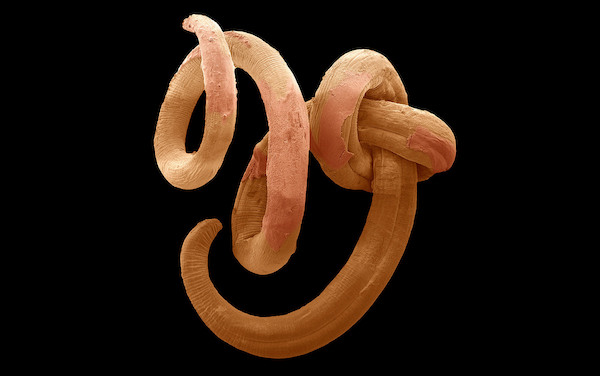
I started out in biomedical research asking what and how, but after stumbling into some inexplicable questions that cannot be addressed by the what and the how, I started asking why. Our Western diet is certainly a factor. And our stressful lifestyle. But we and others are coming to a fascinating conclusion: intestinal worms are almost certainly involved. But it’s not the presence of the worms that is hurting us. To the contrary, the almost complete loss of intestinal worms in modern society is, surprisingly, a very significant problem. Intestinal worms, called ‘helminths’, have caused untold human suffering, killing the weak and disabling the strong. Labelled uniformly as disease-causing parasites by biologists, they have inspired fear and hate, leading to major campaigns aimed at their eradication. The Rockefeller Foundation, for example, was originally formed to eliminate hookworm from the southern US. Their genocidal campaign was very successful, and similar campaigns are now underway in developing countries. This fearsome menace has been virtually eradicated in the US and in western Europe, and we hope to accomplish the same in developing countries. Good riddance.
But what if we erred? What if our bias against a handful of helminths led us to slaughter billions of innocent and even helpful worms? Indeed, my research and the research of many others tell us that helminths are necessary for our health. A barrage of scientific evidence points toward helminths as being important regulators of immune function. Because of this, our genocidal campaign against intestinal worms apparently has a very nasty backlash that nobody saw coming.[…]
Source: https://aeon.co/essays/gut-worms-were-once-a-cause-of-disease-now-they-are-a-cure

 msamba