
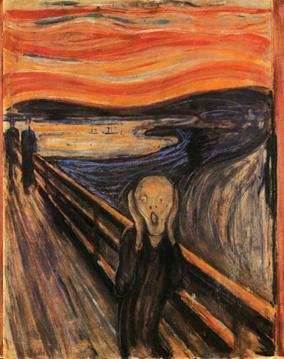
What evolution and nonverbal communication studies tell us about an iconic image
Edvard Munch’s extraordinary 1893 painting The Scream consistently places near the top of various lists of the most recognized and impactful works of art. It’s an iconic image, imitated and parodied countless times. Earlier this year, Jonathan Jones, a long-time art critic with The Guardian, described it as “the ultimate image” for our political age.
While it is hard to disagree with this wry assessment, The Scream transcends politics, of course, and resonates with its admirers for more enduring reasons. Munch depicted a universal human emotional experience, strikingly raw and vivid, with the skeletal and androgynous figure’s face devoid of nuance or subtlety. Yet the remarkable purity and nakedness of the image leaves much to the imagination, as the artist surely intended. Why is our subject screaming?
There has been much analysis about the symbolism of The Scream but, as far as I am aware, none of it addresses the question from the academic perspectives of nonverbal communication and evolution. […]
Read More: Munch’s Scream

 msamba