
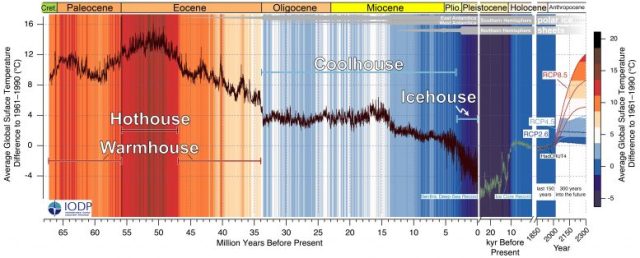
Past and future trends in global mean temperature spanning the last 67 million years. Oxygen isotope values in deep-sea benthic foraminifera from sediment cores are a measure of global temperature and ice volume. Temperature is relative to the 1961-1990 global mean. Data from ice core records of the last 25,000 years illustrate the transition from the last glacial to the current warmer period, the Holocene. Historic data from 1850 to today show the distinct increase after 1950 marking the onset of the Anthropocene. Future projections for global temperature for three Representative Concentration Pathways (RCP) scenarios in relation to the benthic deep-sea record suggest that by 2100 the climate state will be comparable to the Miocene Climate Optimum (~16 million years ago), well beyond the threshold for nucleating continental ice sheets. If emissions are constant after 2100 and are not stabilized before 2250, global climate by 2300 might enter the hothouse world of the early Eocene (~50 million years ago) with its multiple global warming events and no large ice sheets at the poles. Credit: Westerhold et al., CENOGRID
A continuous record of the past 66 million years shows natural climate variability due to changes in Earth’s orbit around the sun is much smaller than projected future warming due to greenhouse gas emissions.
For the first time, climate scientists have compiled a continuous, high-fidelity record of variations in Earth’s climate extending 66 million years into the past. The record reveals four distinctive climate states, which the researchers dubbed Hothouse, Warmhouse, Coolhouse, and Icehouse.
These major climate states persisted for millions and sometimes tens of millions of years, and within each one, the climate shows rhythmic variations corresponding to changes in Earth’s orbit around the sun. But each climate state has a distinctive response to orbital variations, which drive relatively small changes in global temperatures compared with the dramatic shifts between different climate states.
The new findings, published today (September 10, 2020 in the journal Science, are the result of decades of work and a large international collaboration. The challenge was to determine past climate variations on a time scale fine enough to see the variability attributable to orbital variations (in the eccentricity of Earth’s orbit around the sun and the precession and tilt of its rotational axis).
“We’ve known for a long time that the glacial-interglacial cycles are paced by changes in Earth’s orbit, which alter the amount of solar energy reaching Earth’s surface, and astronomers have been computing these orbital variations back in time,” explained coauthor James Zachos, distinguished professor of Earth and planetary sciences and Ida Benson Lynn Professor of Ocean Health at UC Santa Cruz.
“As we reconstructed past climates, we could see long-term coarse changes quite well. We also knew there should be finer-scale rhythmic variability due to orbital variations, but for a long time it was considered impossible to recover that signal,” Zachos said. “Now that we have succeeded in capturing the natural climate variability, we can see that the projected anthropogenic warming will be much greater than that.”
For the past 3 million years, Earth’s climate has been in an Icehouse state characterized by alternating glacial and interglacial periods. Modern humans evolved during this time, but greenhouse gas emissions and other human activities are now driving the planet toward the Warmhouse and Hothouse climate states not seen since the Eocene epoch, which ended about 34 million years ago. During the early Eocene, there were no polar ice caps, and average global temperatures were 9 to 14 degrees Celsius higher than today.
“The IPCC projections for 2300 in the ‘business-as-usual’ scenario will potentially bring global temperature to a level the planet has not seen in 50 million years,” Zachos said.
Critical to compiling the new climate record was getting high-quality sediment cores from deep ocean basins through the international Ocean Drilling Program (ODP, later the Integrated Ocean Drilling Program, IODP, succeeded in 2013 by the International Ocean Discovery Program). Signatures of past climates are recorded in the shells of microscopic plankton (called foraminifera) preserved in the seafloor sediments. After analyzing the sediment cores, researchers then had to develop an “astrochronology” by matching the climate variations recorded in sediment layers with variations in Earth’s orbit (known as Milankovitch cycles).[…]
Continue reading: 66 Million Years of Earth’s Climate History Uncovered – Puts Current Changes in Context

 msamba