
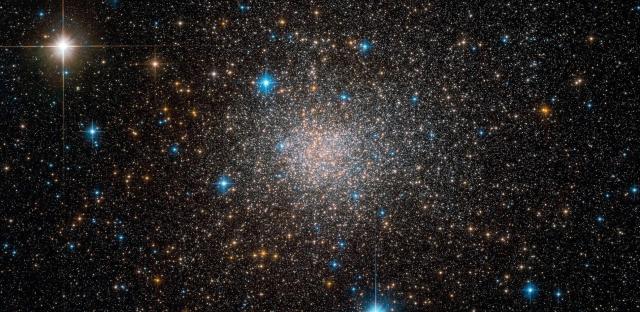
A sparkling mass containing at least half a million stars—and some two dozen pulsars—the globular cluster known as 47 Tucanae is one of roughly 150 ancient stellar clumps orbiting the Milky Way galaxy.
The map that NASA launched in 1972 could lead extraterrestrials to Earth. A new map, nearly 50 years later, provides even better directions.
BY
A HALF CENTURY ago astronomers designed a map that would point to Earth from anywhere in the galaxy. Then they sent it into space, reasoning that any aliens smart enough to intercept a spacecraft could decode the map and uncover its origin. Many movies and TV shows have used variations on this theme as a plot point, but we didn’t borrow it from science fiction. It’s reality.
Truth is, this tale has been part of my family’s lore since before I was born. Growing up, I’d heard stories about the map and seen its depiction on multiple interstellar spacecraft, and several years ago, I found the original, penciled-in pathway to Earth where my parents had stashed it. (More on this later.)
That was an exciting find! Then came the buzzkill: This original map won’t be good for much longer, cosmically speaking. The signposts it uses will disappear within tens of millions of years, and even if they don’t, the map would point toward our home for only a fraction of the 200 to 250 million years it takes the sun and other nearby stars to spin once around the Milky Way.
Sure, the chances of aliens intercepting the map are astronomically improbable—but if that did happen, an outdated map would be useless rather than helpful. And that wasn’t the goal.[…]
More: NASA sent a map to space to help aliens find Earth. Now it needs an update.

 msamba