
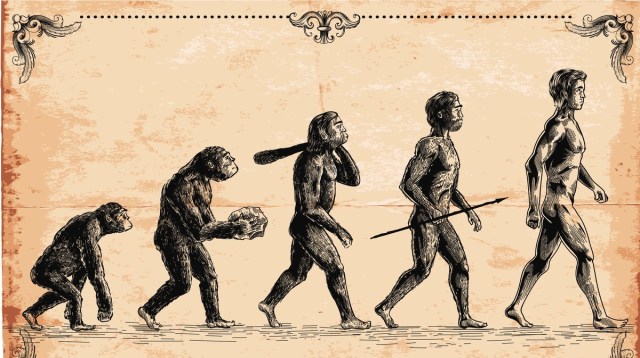
 Professors are starting to orient Charles Darwin within a rich history of people from all cultures who have grappled with the mechanisms of life.

In the summer of 1837, Charles Darwin drew a rudimentary sketch in his notebook, lines of ink that branched out from another. This tree-like doodle would come to represent his theory of evolution by natural selection, a way to visualize how plants and animals adapt in response to their environments. On the top of the page, Darwin scrawled the words, “I think.”
When many students are taught about evolution they learn about Darwin, how he observed bird beaks on the Galápagos Islands, and pieced together one of history’s most significant biological puzzles.
But this narrative, focusing on a singular person’s “I think,” omits a long history of humans contemplating how organisms change over time. Evolutionary musings have existed before Darwin, and some professors and museums are now striving to include that neglected history in curriculums and exhibitions.
Recently, New York University professor James Higham tweeted about how he updated the lectures of his class on primate behavioral ecology, geared to upper-level undergraduates. They now “properly acknowledge Islamic scholarship in this area—especially that of Al-Jahiz (781-869 CE),” Higham wrote. “It seems clear that something like evolution by natural selection was proposed a thousand years before Darwin/Wallace.” (The naturalist Alfred Russel Wallace independently proposed the theory of evolution by natural selection around the same time as Darwin.)
Higham told VICE News he wasn’t taught about Al-Jahiz in his own training; he knew of Al-Jahiz vaguely as a theologian, writer, and scholar, but not a biologist.
“I was struck by the extent to which Al-Jahiz appears to have had not just evolutionary ideas, but many ideas that could be said to be related specifically to the process of evolution by natural selection,” Higham said in an email. “This seems to have included ideas such as competition over finite resources, adaptation in response to the environment, and speciation over time as an outcome.”
His tweet referenced a graph of eight pre-Darwin Muslim scholars who wrote about evolutionary ideas, from “An untold story in biology: the historical continuity of evolutionary ideas of Muslim scholars from the 8th century to Darwin’s time,” a 2017 paper by senior author Rui Diogo, an assistant professor at Howard University. Higham plans to include Al-Jahiz and other pre-Darwin scholars in his large intro class on human origins as well. Other academics replied to Higham’s tweet, saying they were taking similar action. Like Andy Higginson, an ecologist and Senior Lecturer at University of Exeter who responded, “I did the same for a lecture last week!”
There is no evidence that Darwin knew of Islamic scholars from the 9th or 10th centuries, said Salman Hameed, the director of the Centre for the Study of Science in Muslim Societies at Hampshire College in Amherst, Massachusetts—but the purpose of including mention of past scholars isn’t to say that Darwin copied them, or drew from them, or to in any way diminish his legacy.
“I think it’s good for students to know that other societies have thought about these things,” Hameed said. “I think it enriches our story of science. The story of science in some sense should be a story of humans, not a story of a couple of individuals coming up with these great things—but a human endeavor.”
Noting the history of evolution-like ideas throughout history and cultures can broaden our understanding of how ideas themselves evolve—in waves, needing refinement, and inevitably influenced by the cultures and historical contexts they exist in. Rather than downplaying the accomplishments of figures like Darwin, including pre-Darwinian scholars can orient him within a rich legacy of people who have grappled with the mechanisms of life, while also serving as an opportunity to assess which historical ideas we consider to be significant and “scientific,” and which ones we don’t.[…]
Continue reading: A Thousand Years Before Darwin, Islamic Scholars Were Writing About Natural Selection

 msamba