
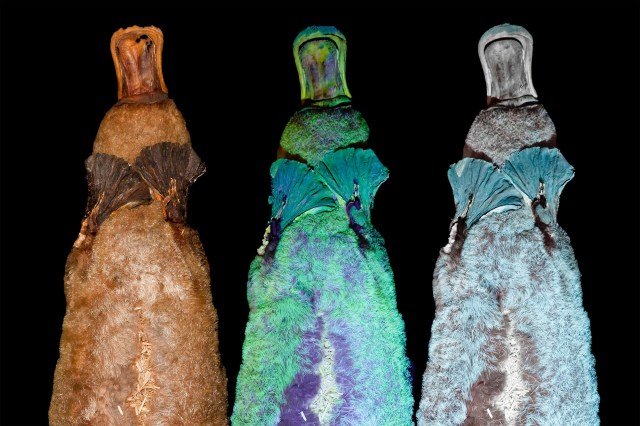
 From left: visible light, ultraviolet light, and yellow-filtered UV light. Photo by Jonathan Martin
The platypus has puzzled researchers for centuries. From its venom-filled spurs, milk-secreting skin, and ability to eat a quarter of its body weight every day, the egg-laying mammal even had European zoologists believing it was a hoax well throughout the 19th Century.
A recent study published in the journal Mammalia adds to the duck-billed creature’s lengthy list of peculiarities. Apparently, when illuminated with ultraviolet light, the platypus’s dull, brown coat glows. The discovery happened after Jonathan Martin, an associate professor of forestry at Wisconsin’s Northland College, shined a UV flashlight on a flying squirrel in his backyard, which he found emitted a candy-colored pink hue. He then joined a few colleagues to visit Chicago’s Field Museum, where they replicated the process on the institution’s platypus collection, revealing the animals’ bright green and purple coat.
According to one study, the fluorescent substances are found embedded within mammals’ hair follicles, although scientists aren’t sure why.[…]
More: Under UV Light, Platypuses Radiate a Fluorescent Green-Blue Hue—But Scientists Aren’t Sure Why

 msamba