
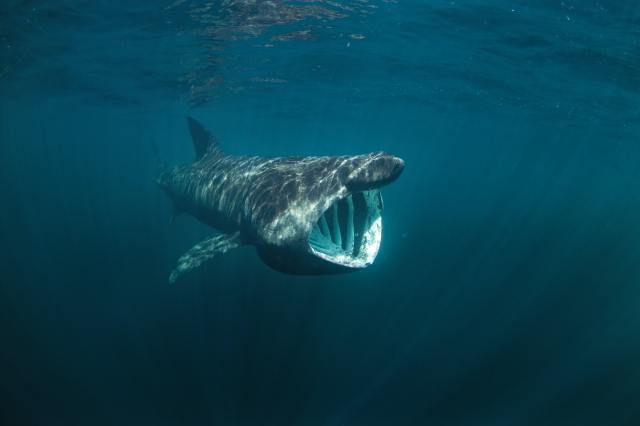
 The latest research reveals basking sharks are not lone predators but rather family-minded creatures with a fancy for fine dining with their own folk.



Picture the scene. Swimming off Scotland’s west coast during a summer holiday you notice a large dark shark nearly 10 metres long headed towards you. A prominent triangular dorsal fin cuts the surface, the powerful rhythmically beating tail driving it silently through the cloudy green depths. You’re transfixed by a cavernous mouth large enough to swallow a seal.
Musing this may be your last swim, it might be surprising to learn this leviathan of the deep is a harmless yet endangered gentle giant. It has little interest in humans, focusing on some unseen bounty of the warmer summer waters: zooplankton, the tiny creatures found near the surface of the ocean.
This is the basking shark (Cetorhinus maximus), once common off western Europe, feeding on the annual plankton bonanza of the European shelf.
Our recent study suggests holidaymakers and basking sharks have much in common. They make temporary forays into these higher latitudes, travelling familiar routes with extended family, feeding on local fare at well-known places visited on previous trips.
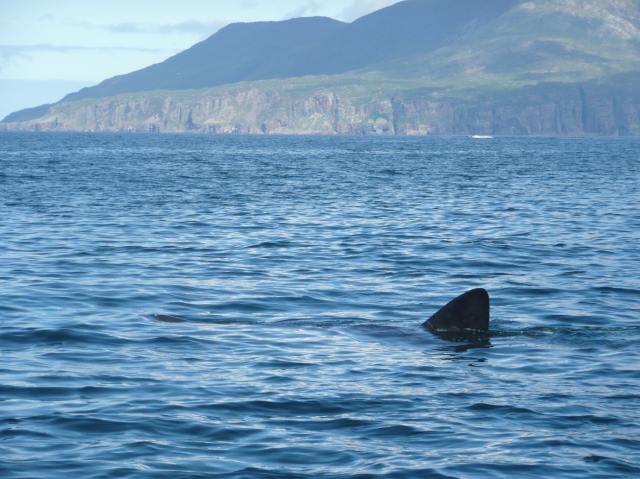
Areas supporting high densities of zooplankton are like tourist traps, drawing basking sharks from across the Atlantic in late spring and summer. Hundreds converge in inshore surface waters on the Scottish west coast, Ireland and Isle of Man.
Once hunted for its oily liver across all oceans, basking sharks in the the north-east Atlantic were primarily targeted, with more than 80,000 slaughtered in the second half of the 20th century. This earned the world’s second biggest fish (after the whale shark) a place on the International Union for Conservation of Nature´s Red List. A critical indicator of biodiversity, this catalogue of species under threat of global extinction makes depressing reading.
Saving our sharks
Conservation management of the basking shark demands knowledge of its ecology and movement patterns. These slow-swimming coastal predators easily traverse the equator and ocean basins, moving from one legislative domain to another. Identifying important feeding sites and routes popular for annual migrations can therefore help countries enact effective protection.
Difficult to track and observe, satellite tagging has revealed shark movements, showing use of the ocean throughout a year. One study suggests that basking sharks have an attachment to particular areas, returning annually to feeding sites, a behaviour known as seasonal site fidelity.[..]

 msamba