
Jo Adetunji
Managing Editor
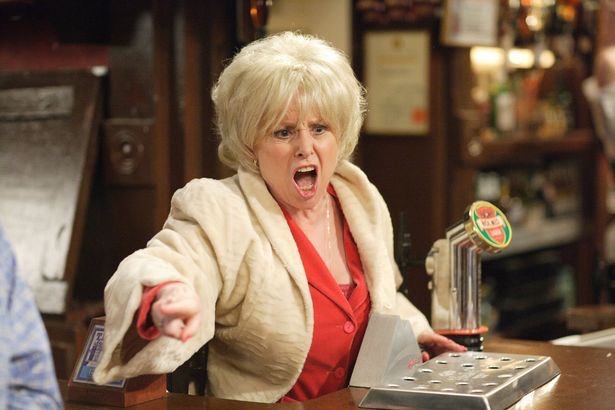 Barbara Windsor was the Cockney queen of EastEnders but you’re more likely to hear her famous accent in Essex now rather than London.
The word “cockney” conjures up a plethora of London-based cultural expectations. Maybe you envisage the muted criminality of Only Fools and Horses, which epitomises the centuries-old depiction of cockneys as the “playful rogue”. Or maybe you think of ’er indoors: headstrong kitchen matriarchs bustling over dusty, shoeless children who dart in and out of labyrinths of alleys and cobbled streets. Or perhaps what comes to mind is the legend of the Bow Bells in the City of London, within whose earshot a true cockney is supposedly born.
Or maybe you think of Dame Barbara Windsor, who died on December 9. She was a cockney icon, born in 1937 in Shoreditch, east London. She was best known for her impassioned cries of “get outta my pub!” as Peggy Mitchell in the BBC One soap opera EastEnders.
Windsor encapsulated popular imaginings of the cockney; she was joyous, riotous, staunchly working class and spoke with an unmistakably cockney accent. Cockneys are often described as the white working class in east London who speak, well, cockney. But there is more to it than that. Windsor’s cockney accent is relatively far removed from the accent now spoken by many young people in modern-day east London – Multicultural London English – which has supplanted cockney.
So is the cockney accent soon be brown bread (dead in cockney rhyming slang)? My research suggests that cockney may instead be alive and well in Essex – although the people that speak it may not consider themselves cockney.
Who speaks cockney?
Since Barbara Windsor’s rise to fame, there has been a dramatic reconfiguration of who is and who speaks cockney. Although east London is the spiritual home of cockney, the cockney culture and accent may now be most prolific in Essex.
Essex has long been one of the most popular destinations for day trips and holidays for east Londoners. But after the second world war, many relocated to Essex, leading to what is now known as the cockney diaspora. This large-scale movement was provoked by many interrelated factors.
Some families chose to leave behind the poverty and overcrowding in east London, others lost their jobs through deindustrialisation, such as the closure of the London Docks. Others lost their homes due to the 1920s-1960s government-led slum-clearance programmes. As part of the slum-clearance programmes to Essex, many post-war new towns and council estates were constructed, such as Becontree, which at the time the world’s largest estate.

Another such estate was Debden, which was the research site of sociologists Michael Young and Peter Willmott’s highly influential Family and Kinship in East London. This book traced the relocation of cockneys to Essex, which supposedly damaged family and kinship ties.
Debden is also where I’m from. Both sets of my grandparents were moved from east London to council houses in Essex by the then London County Council. My dad was born in his parents’ home in leafy Debden, and my sister and I were subsequently brought up and schooled there.
Like me, many in Debden are born into families with direct links to the East End and are firmly part of the cockney diaspora, but does that make us cockney? Well, it’s complicated.[…]
Continue reading: Barbara Windsor: you’re more likely to hear a cockney accent in Essex than east London now

 msamba