
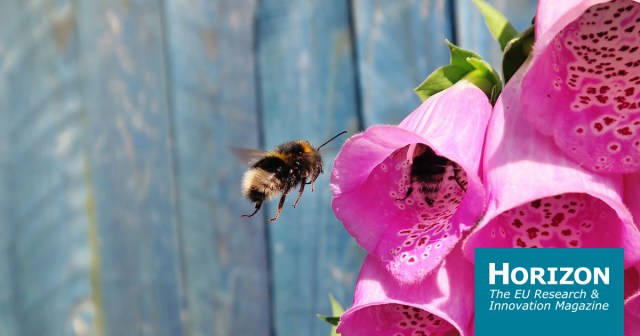
 Flying insects such as bees and moths have secret senses that allow them to ‘feel’ nearby flowers and navigate over long distances, according to new research.
Armed with sensitive antennae and wide-angled compound eyes, bees have a sophisticated set of senses to help them search out pollen and nectar as they buzz from flower to flower.
But new research is revealing that bumblebees may employ another hidden sense that lets them detect when a flower was last visited by another insect.
Professor Daniel Robert, an expert in animal behaviour and senses at the University of Bristol, UK, has discovered that bumblebees have the ability to sense weak electrostatic fields that form as they fly close to a flower.
‘A bee has a capacity, even without landing, to know whether a flower has been visited in the past minutes or seconds, by measuring the electric field surrounding the flower,’ Prof. Robert explained.
The discovery is one of the first examples of electroreception in air. This sense has long been known in fish such as sharks and rays, which can detect the weak electrical fields produced by other fish in the water. Water-dwelling mammals such as platypus and dolphins have also been found to use electric fields to help them hunt for prey.
But rather than hunting for fish, bees appear to use their ability to sense electrical fields to help them find flowers that are likely to be rich in pollen and nectar.
Charge
Bees develop an electrostatic charge because as they fly they lose electrons due to the air rubbing against their bodies, leading to a small positive electric charge. The effect is a bit like rubbing a party balloon against your hair or jumper, except the charge the bees accumulate is around 10,000 times weaker.
Flowers, by comparison, are connected to the ground, a rich source of electrons, and they tend to be negatively charged.
These electrostatic charges are thought to help bees collect pollen more easily. Negatively charged pollen sticks to the positively charged bee because opposite charges attract. Once the pollen sticks to the bee, it too becomes more positively charged during flight, making it more likely to stick to the negatively charged female part of a flower,[…]

 msamba