
By
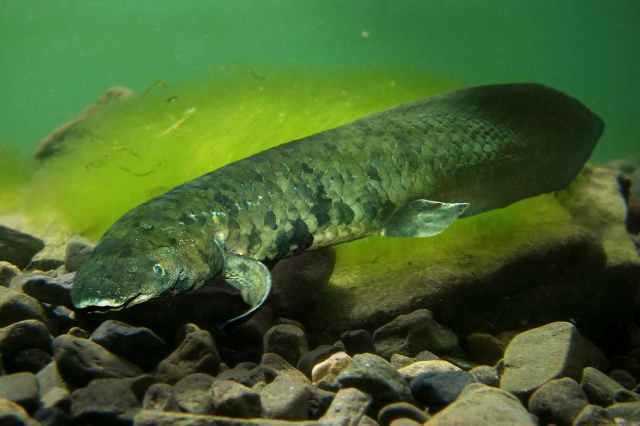 The Australian lungfish’s genome is around 14 times larger than the human one, and its DNA confirms it is closely related to land-based animals with a backbone
The Australian lungfish has the largest genome of any animal so far sequenced.
Siegfried Schloissnig at the Research Institute of Molecular Pathology in Austria and his colleagues have found that the lungfish’s genome is 43 billion base pairs long, which is around 14 times larger than the human genome.
Its genome is 30 per cent larger than that of the previous record holder: the axolotl, a Mexican amphibian that the team sequenced in 2018.
The Australian lungfish (Neoceratodus forsteri), native to south-east Queensland, has changed little in appearance since the time when animals began transitioning from a water-based to a terrestrial-based lifestyle, says Schloissnig.
The animal’s fins are fleshy and flipper-like, and it has a single dorsal lung, which it can use to breathe air at the water’s surface.
Previously, it was unclear whether lungfish or coelacanths – a group of archaic fish found in the Indian Ocean and around Indonesia – were more closely related to land-based vertebrates such as mammals and birds.
The new genomic analysis shows unequivocally that lungfish are more closely linked to the evolutionary line that gave rise to four-legged animals. Coelacanths diverged earlier, while lungfish branched off 420 million years ago.[…]
Read more: Australian lungfish has largest genome of any animal sequenced so far | New Scientist

 msamba