
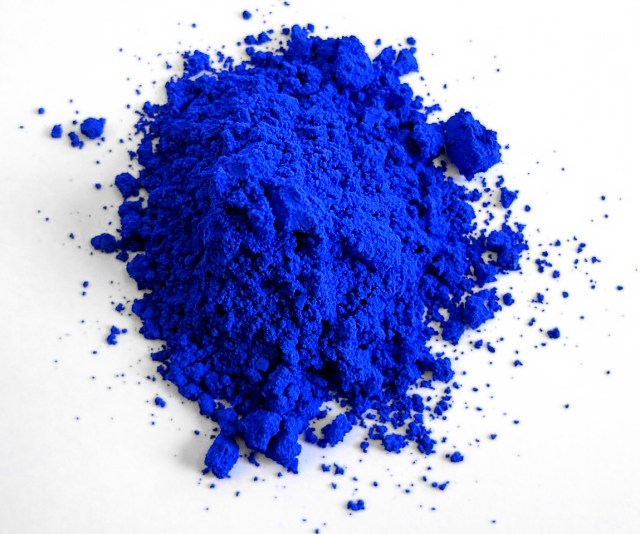
 Photo via Oregon State University
“Color is part of a spectrum, so you can’t discover a color,” says Professor Mas Subramanian, a solid-state chemist at Oregon State University. “You can only discover a material that is a particular color”—or, more precisely, a material that reflects light in such a way that we perceive it as a color. Scientific modesty aside, Subramanian actually has been credited with discovering a color—the first inorganic shade of blue in 200 years.
Named “YInMn blue” —and affectionately called “MasBlue” at Oregon State—the pigment’s unwieldy name derives from its chemical makeup of yttrium, indium, and manganese oxides, which together “absorbed red and green wavelengths and reflected blue wavelengths in such a way that it came off looking a very bright blue,” Gabriel Rosenberg notes at NPR. It is a blue, in fact, never before seen, since it is not a naturally occurring pigment, but one literally cooked in a laboratory, and by accident at that.
The discovery, if we can use the word, should justly be credited to Subramanian’s grad student Andrew E. Smith who, during a 2009 attempt to “manufacture new materials that could be used in electronics,” heated the particular mix of chemicals to over 2000 degrees Fahrenheit. Smith noticed “it had turned a surprising, bright blue color [and] Subramanian knew immediately it was a big deal.” Why? Because the color blue is a big deal.

 msamba