
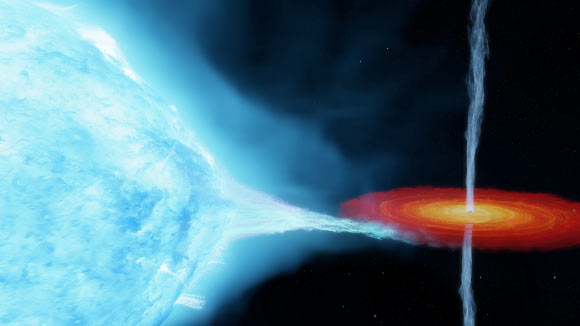
A black hole in the Cygnus X-1 binary system is so massive that it challenges current stellar evolution models.
Discovered in 1964, Cygnus X-1 is an X-ray binary system located in the constellation Cygnus.
The primary star, HD 226868, is a hot supergiant revolving about an unseen compact companion with a period of 5.6 days.
The companion is a so-called stellar-mass black hole, a class of black holes that comes from the collapse of a massive star.
Cygnus X-1 was the focus of a famous scientific wager between physicists Stephen Hawking and Kip Thorne, with Hawking betting in 1974 that it was not a black hole. Hawking conceded the bet in 1990.
“Stars lose mass to their surrounding environment through stellar winds that blow away from their surface,” said Professor Ilya Mandel, an astrophysicist at Monash University and the ARC Centre of Excellence in Gravitational Wave Discovery (OzGrav).
“But to make a black hole this heavy, we need to dial down the amount of mass that bright stars lose during their lifetimes.”
“The black hole in the Cygnus X-1 system began life as a star approximately 60 times the mass of the Sun and collapsed tens of thousands of years ago,” he added.[…]
https://vimeo.com/icrar/cygnusx-1
Continue reading: http://www.sci-news.com/astronomy/cygnus-x-1-black-hole-09373.html

 msamba