
GRACE EBERT
 Detail of “Passage, when momma lets my braids flow down my back,” wool, synthetic braiding hair, wood, plaster, resin, satin. Collaborators are Kiki Jewell, Nyja Amos, Grace Jewell. Photo by David Hunter-Hale. All images © Nastassja Swift
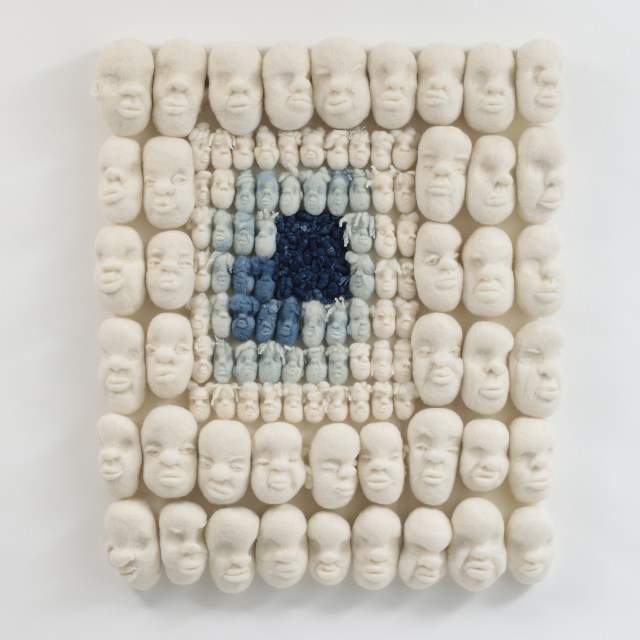 “Inner City,” indigo-dyed wool and felt fabric. Photo by David Hunter-Hale
In her salient text, In The Wake: On Blackness and Being, scholar Christina Sharpe delves into the multiple definitions of “wake,” which span from “the path behind a ship, keeping watch with the dead, (to) coming to consciousness.” “In the wake,” Sharpe writes, “the past that is not past reappears, always, to rupture the present.” Largely focused on conversations around anti-Blackness and continued violence, the book is rooted in the afterlife of slavery and what sentiments, practices, and memories linger into the current moment, questions that similarly ground the work of artist Nastassja Swift.
Through fiber-based figures often arranged in larger gatherings, Swift explores various narratives tied to Blackness, particularly those that relate to water and ancestral presences. “I’m interested in taking those things as starting points and imaging a space or happening that involves my sculpture and allows me to think through a hypothetical rooted in that memory or history,” the Virginia-based artist says. She derives these stories from texts like Sharpe’s, discussions with friends, and in one instance, a conversation with an older Black woman at a Toni Morrison film screening. […]
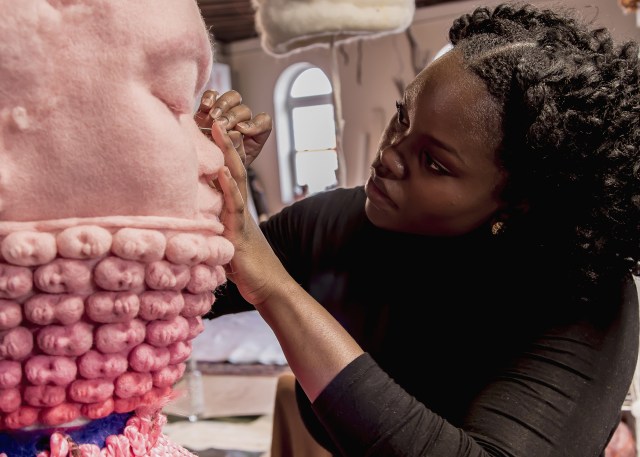 Swift working on “Passage, when momma lets my braids flow down my back.” Photo by Nalan Smart
More: Figurative Wool Sculptures by Nastassja Swift Explore the Memories and Narratives of Blackness

 msamba