
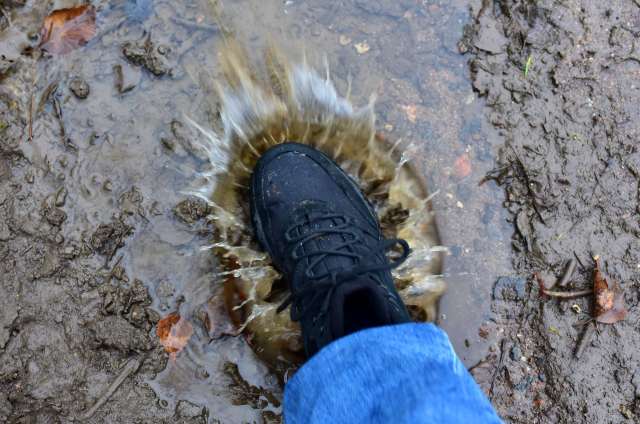
 Puddles can be valuable wildlife havens. Maksim Safaniuk/Shutterstock
Puddles are an often-ignored but crucial habitat for rare and unusual wildlife.
As the new year arrived in 2016, my home city of Newcastle upon Tyne was briefly the centre of global attention – for a puddle. The Drummond Puddle, as it was grandly known, was a watery hazard placed perfectly where converging footpaths funnelled a daily stream of victims to their doom. To the wonderment of the world, their fate was livestreamed over the internet to more than half a million viewers.
But puddles are not merely a source of delight for wicked-minded onlookers. We can all, surely, remember the joy of splashing in a puddle – a universal example of creative play and getting to know the environment.
And yet, the conservation value of these tiny sites is still largely unappreciated. For puddles can be valuable wildlife havens too.
One study of the invertebrate inhabitants of puddles in the UK countryside found a majority of these sites had a high conservation value, primarily due to the rare, specialist animals they hosted. Puddles may be commonplace, but their wildlife need not be.
Your own private pool
The tiny, fragmented, ephemeral world of puddles creates the ideal habitat for some species. The isolation and brief life of many of these mini-ponds keeps long-lived, larger predators and competitors at bay, opening up opportunities for more “live fast, die young” life.
In the UK, the most famous examples are the fairy shrimps of puddles on Salisbury Plain in Wiltshire. Large areas of Salisbury Plain are given over to military training, and the churning tracks of tanks create many temporary pools that house these muddy lodgers.
The eggs of the fairy shrimp are resistant to drought. They remain dormant, but viable, for many years and are spread by the wind or, in the case of Salisbury Plain, are carried in the mud spattered on military vehicles.
When rain fills a track in the dried mud, fairy shrimp eggs hatch almost immediately. The shrimps grow quickly to lay a new generation of eggs before their puddle dries.[…]
Continue reading: The secret world of puddles
Associate Professor, Ecology, Northumbria University, Newcastle

 msamba