
MARCH 8, 2024 GRACE EBERT
 “The Fishman” (1973), wood, plaster, paint acrylic, and glass eyes, 68¼ x 28 x 33¼ inches. Photo by Brenda Bieger, Buffalo AKG Art Museum, © Estate of Marisol/Artists Rights Society (ARS), New York. All images courtesy of Toledo Museum of Art
Rising to fame in the 1960s, Marisol was one of those rare figures who garnered both critical acclaim and celebrity “it girl” status.
Rising to fame in the 1960s, the Venezuelan-American artist Marisol was one of those rare figures who garnered both critical acclaim and celebrity “it girl” status. She was enigmatic, creating a varied and undeniably compelling oeuvre across mediums and concerns and forging bonds with art world fixtures like Andy Warhol. During the height of the artist’s career, she was famously interviewed by Gloria Steinem for Glamour, one of many mainstream magazines that featured her for her coveted style and mysterious allure.
Born María Sol Escobar in 1930s Paris, Marisol quickly adopted the singular nickname first used by her mother. She relocated with her father to Los Angeles as a teenager before moving to New York in the early 1950s, where she saw an exhibition of pre-Columbian clay pieces that prompted an evolution of her practice from painting to sculpture. Not long after, she began working with wood, the medium for which she’s most known today.
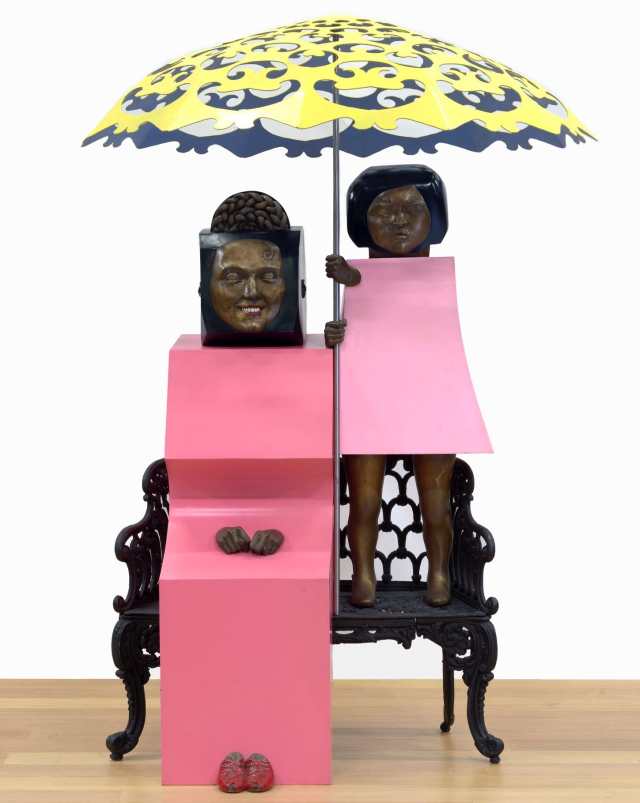 “Mi Mama Y Yo” (1968), painted bronze and aluminum pole, 73 x 56 x 56 inches. Photo by Brenda Bieger, Buffalo AKG Art Museum, © Estate of Marisol/Artists Rights Society (ARS), New York
A major retrospective on view now at the Toledo Museum of Art explores Marisol’s under-appreciated legacy, presenting 244 sculptures, self-portraits, sketches, underwater films, photos, and more. Included are several of the artist’s abstract figures with their angular, boxy bodies and softer defining features like hands and faces.
“Mi Mama Y Yo,” for example, portrays a mother and child, their torsos defined as bright pink blocks. The furious, young girl grasps an ornate umbrella as she stands on a bench next to her smiling, disaffected parent. Similar concerns about loneliness, social structures, and fragmented lives frequently emerge in the artist’s works, which broadly explore relationships within oneself, humanity, and the natural world.
 “Untitled (Marisol with her sculpture ‘The Fishman,’)” (1973), giclee print. Photo digitized by Amanda Smith, Buffalo AKG Art Museum
Even at the height of her fame, Marisol was reclusive and frequently retreated from the art world following a successful exhibition. She would, however, plant her own body and face into many of her works as a way to embed her presence wherever her works were on view. One of the most iconic examples is “The Party,” an assemblage of 15 figures who congregate in ball gowns and bear the artist’s likeness.
Mariosol’s popularity faded in the 1970s when she was arguably creating some of her most prescient works, including “The Fishman.” A life-sized sculpture standing taller than the artist, the hybrid figure with webbed feet holds a decapitated fish in its left hand. This surreal work is one of many that speaks to her anxieties about the climate and ecological devastation, concerns that are unavoidable today. […]

 msamba