
February 5, 2025
Art
Social Issues
Kate Mothes
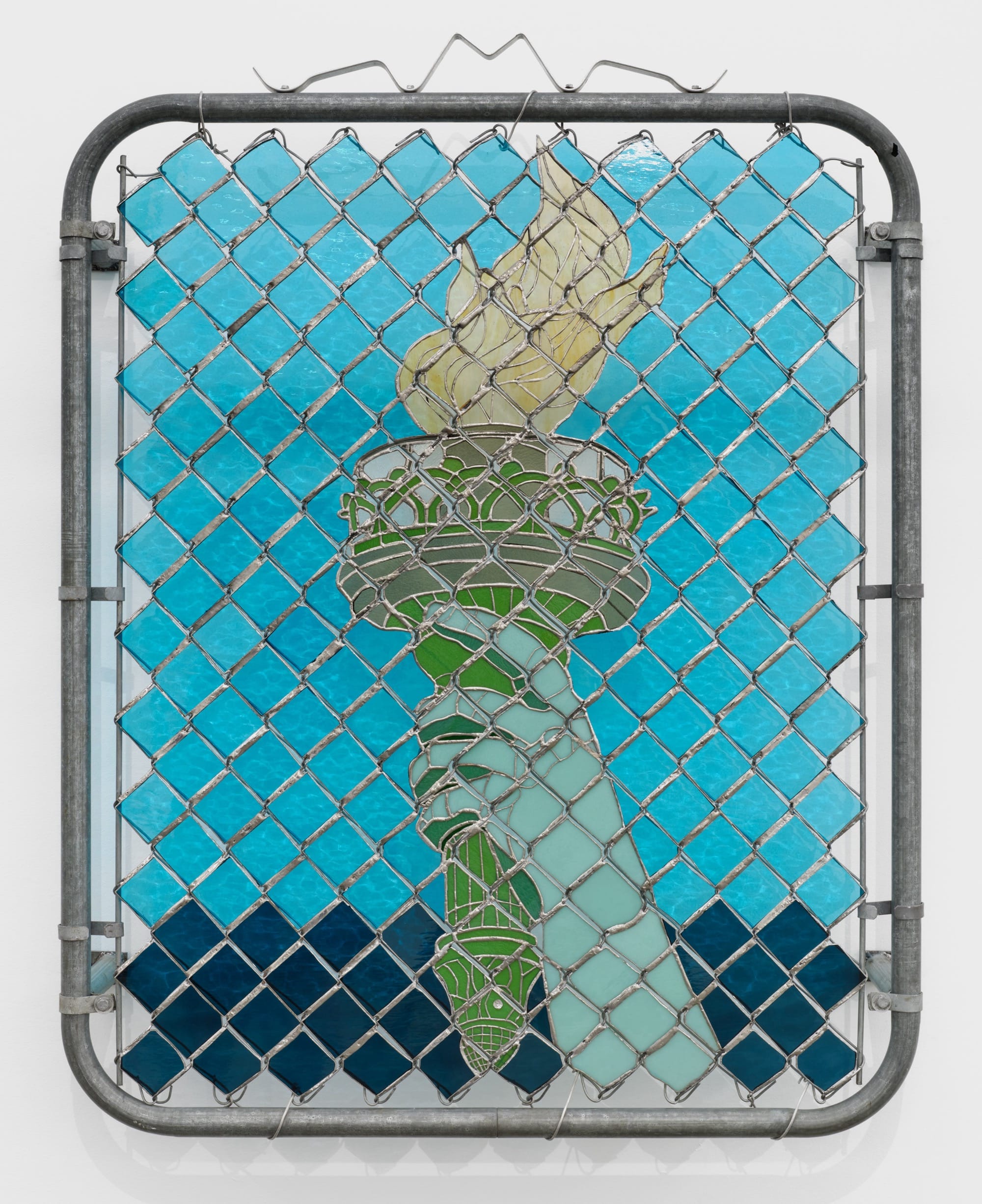 “give me your tired, your poor, your huddled masses yearning to breathe free, the wretched refuse of your teeming shore. send these, the homeless, tempest-tossed to me, I lift my lamp beside the golden door” (2023), chain-link fence, steel, stained glass, lead, and aluminum, 48 x 38 x 6 inches. All images courtesy of the artist and Sebastian Gladstone Gallery
Mesoamerican codices, national symbols, and motifs found in older European churches inspire Timo Fahler’s mixed-media works.
The creation of stained glass can be traced back to ancient Egypt and Rome, but we most often associate it with its popularity in Western Christianity, as in the biblical narratives adorning chapels and cathedrals. For Timo Fahler, this tradition forms the foundation of a multimedia practice influenced by Mesoamerican codice imagery, national symbols, and motifs found in older European churches.
Stained glass is a “storytelling medium in which I get to draw from everything I experience, everything I study, read, believe in, and even distrust,” Fahler tells Colossal. “We are floating in a unique era of questioning reality, the last gasp of the living generation before automation integrates itself via AI, ChatGPT, and digital interface.” He views his practice as depicting this era and even, in a way, immortalizing it.
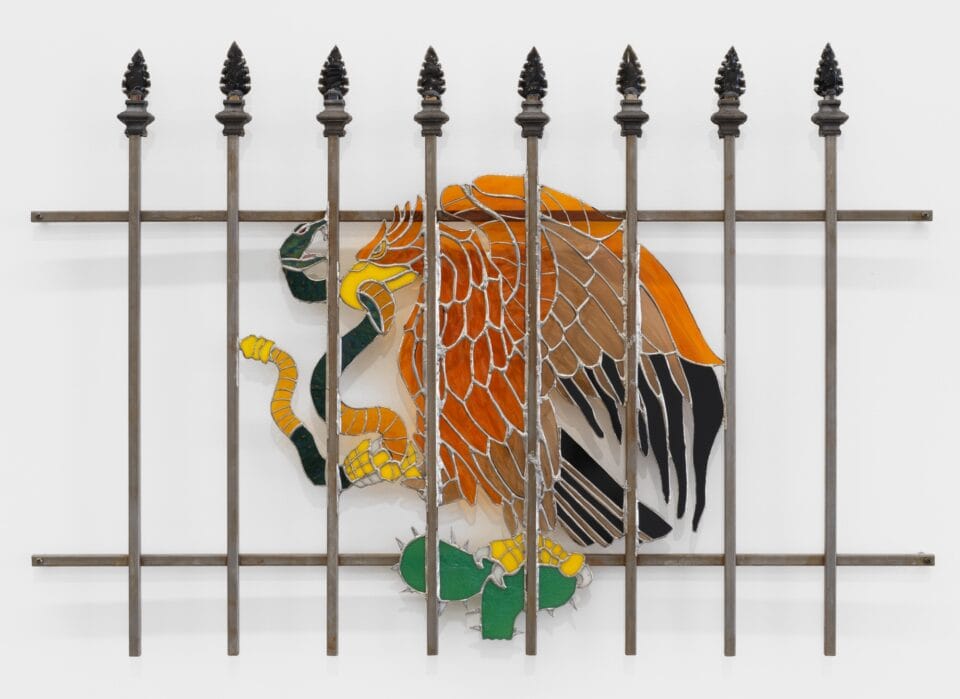 “topos chrysaetos” (2023), steel, cast iron, stained glass, lead, tin, and obsidian, 27 x 41 x 2 inches
Fahler first worked with lampworking glass while studying ceramics at the Kansas City Art Institute, which sparked an ongoing interest in the medium. Recently, he began incorporating it into what he calls “rebar drawings,” which form the foundation of much of his work. “I was curious about letting the unpredictability of light become a part of the ‘materials’ I work with,” the artist says.
Many of Fahler’s sculptures are framed or supported by heavy-duty metals like rusted steel, iron fences, and gates. Stained glass hovers a few inches from the wall, casting colorful shadows. For his most recent works, Fahler places barriers atop the glass to consider not only the viewer’s relationship to the image but also the implications of people being barred from freedoms and knowledge. “I draw from a lot of different sources—historical, mythological, and fantastical—all of which encompass my ‘heritage,’” the artist says.
In a piece titled after the poem “New Colossus” by Emma Lazarus, which is carved in bronze on the Statue of Liberty’s pedestal, Fahler uses a gate to frame a detail of Lady Liberty’s arm constructed of tiny glass squares soldered to the facets of a chain-link fence. Historically a potent symbol of welcome, amnesty, and inclusiveness, the statue in this context references how today, new immigrants’ access is more troubled and often blocked. […]
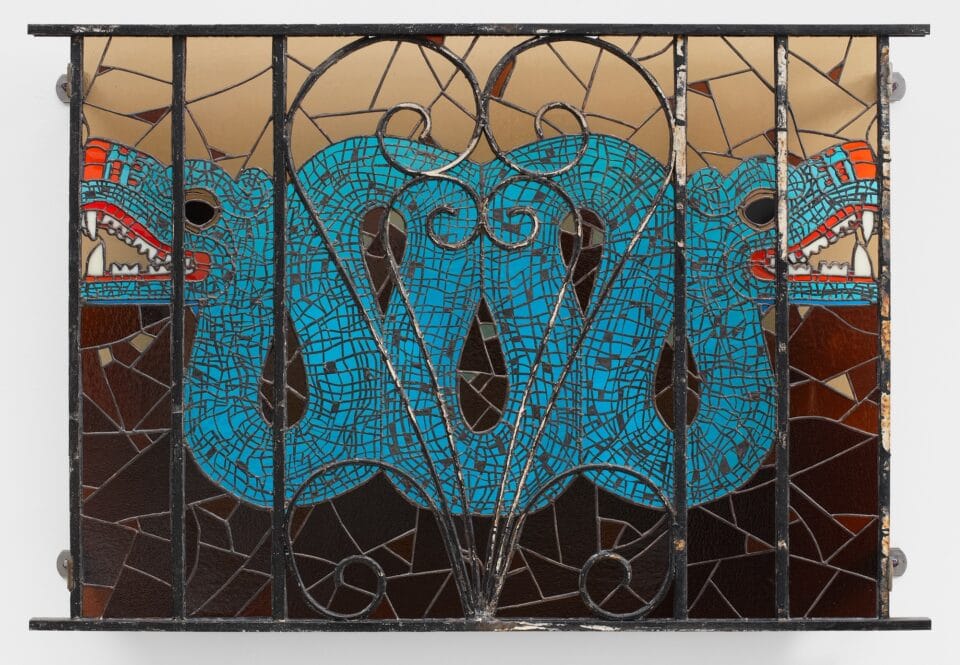 “two-headed serpent” (2023), mirror steel, cast iron, stained glass, copper, and lead, 30 x 45 x 4 inches
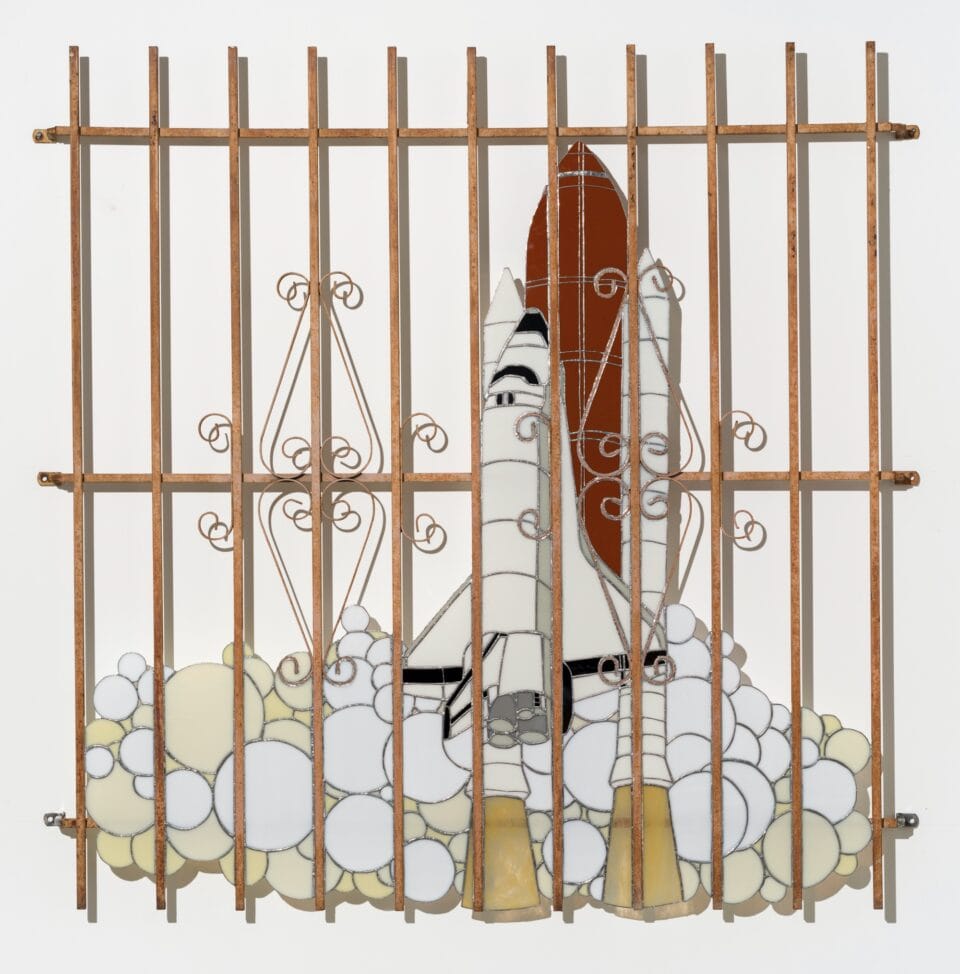 “Space Shuttle Challenger (OV-099)” (2023), fence, steel, stained glass, and lead, 64 x 59.5 x 3.5 inches
More: Timo Fahler’s Stained-Glass Sculptures Question Symbols and Curtailed Freedoms

 msamba