
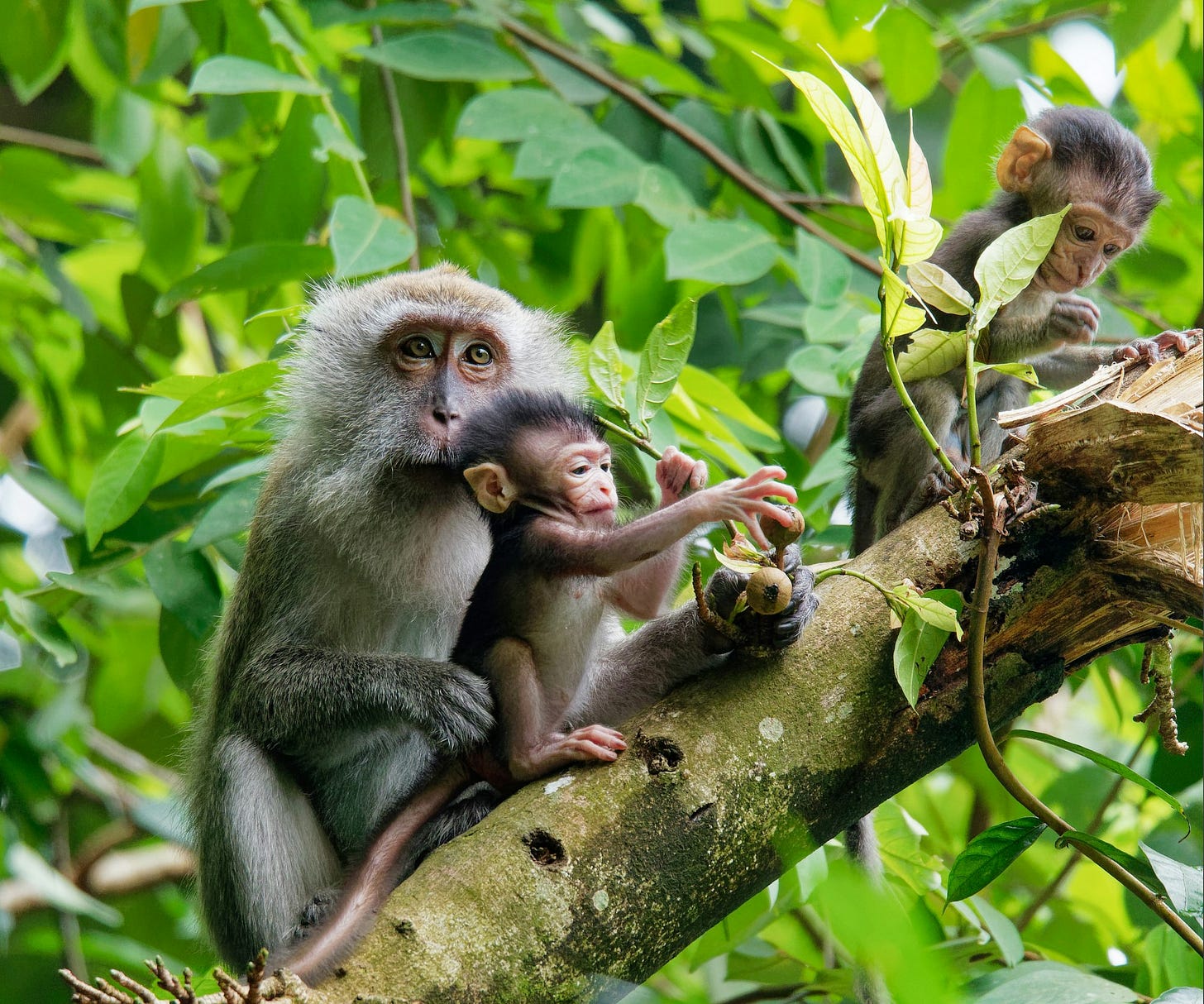
 Photo by Leslie Low / Unsplash
The etymology of our words for living primates gives some insight into how common ideas adjusted to new scientific knowledge.
In scientific English, today we often distinguish between “monkeys” and “apes” in a meaningful way. Apes are the tail-less primates of the Old World that are close relatives of humans within the superfamily Hominoidea. Monkeys are (mostly) tail-bearing primates that are more distant relatives of ours. The monkeys are categorized into two different superfamilies: Ceboidea in the Americas and Cercopithecoidea in Africa, Asia, and Europe.
I’ve written before about how this distinction in English between “ape” and “monkey” can be confusing to anyone not deeply immersed in the taxonomy of primates. Humans are not phylogenetically separate from living great apes; the same common ancestors that connect those apes also are our ancestors. In other words, “apes” in English are not a proper monophyletic group, unless humans are also included. The same is true of “monkeys” – no way of grouping the ceboid and cercopithecoid monkeys is monophyletic unless the apes and humans are also included. (The branch that includes all of these primates is known as the Anthropoidea).
One of the most irritating aspects of talking with people about this is their lack of awareness of common terms in other languages. A certain chauvinistic type of scientist thinks that English words are the only ones that matter.
Just as most English speakers do not make the ape-monkey distinction the same way that taxonomists do, most other languages do not make an ape-monkey distinction in the way that English does.
This raises the question of exactly how English ended up with two distinct words for anthropoid primates, when England has no native non-human primates. It turns out that etymologists really don’t have a very good understanding of this.
A recent post on the Oxford English Dictionary blog looks into the history of the words “ape” and “monkey” in English: “Wrenching an etymology out of a monkey”.
The author, Anatoly Liberman, suggests that “monkey” has its origin in Dutch or Low German, and relates several stories that provide possible origins for the English word. But he also notes that these ideas do not satisfactorily explain superficially similar words in many other languages.
He offers the possibility that these words might have been borrowed from common sources as the primates themselves were traded as captive animals into different populations.
One might suggest that in French and Spanish we are dealing with the Germanic noun that lost its suffix, but this would hardly be a convincing solution. Also, Italian mona was recorded a hundred years before monkey surfaced in English, and a loan from German or Dutch is probably out of the question. I would risk the hypothesis that the Romance names of the monkey have nothing to do with their Germanic look-alikes. In Kanarese, a Dravidian language, the male monkey is called manga; a related Tamil noun sounds mandi. One may perhaps ask whether a migratory culture word for the monkey, known from India to northern Germany, enjoyed some popularity in the past. It may not be for nothing that so many similar simian forms have been found. If some such word traveled with the animal, in every country speakers would adapt it slightly under the influence of folk etymology. Whatever the answer, I believe that, as regards the etymology of Engl. monkey, both monks and the medieval animal epic should be left in peace.
The word “ape” comes down from Old English, and has cognate forms in German and other Germanic languages. In English until the twentieth century, “ape” could refer to any monkey or primate. […]
Read more: https://www.johnhawks.net/p/how-did-english-come-to-have-different-words-for-ape-and-monkey
Share this:
- Share on Facebook (Opens in new window) Facebook
- Share on Pinterest (Opens in new window) Pinterest
- Share on Tumblr (Opens in new window) Tumblr
- Share on Reddit (Opens in new window) Reddit
- Share on WhatsApp (Opens in new window) WhatsApp
- Print (Opens in new window) Print
- Email a link to a friend (Opens in new window) Email
- More

 msamba