
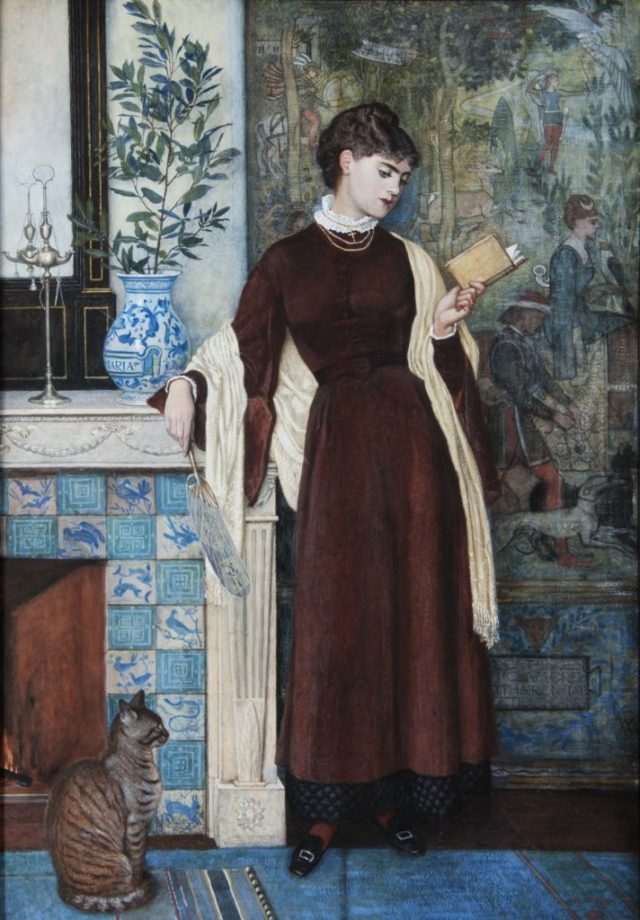
At Home: A Portrait, 1872 (tempera on paper) by Walter Crane,(1845-1915); Courtesy Leeds Museums and Galleries (Leeds Art Gallery)
The Laing Art Gallery is exploring the sinister implications of a popular theme in 19th-century painting: the depiction of the interior as a ‘gilded cage’
The idea of imprisonment might not immediately spring to mind when gazing at the sumptuous paintings of women in aesthetic interiors that proliferated in the Victorian and Edwardian periods.
But beyond the escapism and layered symbolism – not to mention the brooding sensuality and lust – there lies an overt and sinister element, which if you look again turns these aesthetic and medieval-inspired ‘sanctuaries’ into gilded cages that confine the young women that inhabit them.

Laus veneris, Edward Burne-Jones (1833–1898) Courtesy Laing Art Gallery
The Laing Art Gallery is tackling this often glossed-over element of the artwork of the period with a fascinating exhibition spanning the Victorian and contemporary art worlds and, as you might expect, the Pre-Raphaelites and their inheritors are the prime culprits.
For all their attempts to cast women as strong characters, Edward Burne-Jones, Dante Gabriel Rosetti et al were among many whose ornamentally draped subjects were effectively depicted as captives. And, as this exhibition shows, for some Victorian artists women were even arguably on a par with the wall hangings and pots they dolefully gazed upon, as they blended into the wallpaper or the couches they languidly reclined on.[…]

Fiona Tan, Nele/Nellie 2013, courtesy the artist and Frith Street Gallery, London.
More: https://museumcrush.org/how-victorian-artists-trapped-women-in-a-gilded-cage/

 msamba