
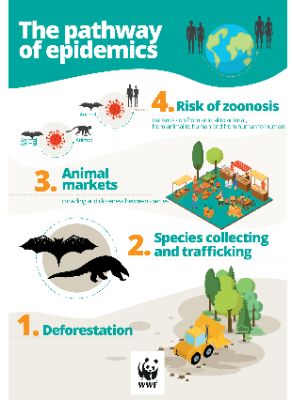
This World Health Day, the world is grappling with the worst public health emergency in recent memory. The recent outbreak of COVID-19 has brought the link between zoonotic diseases – those transmitted from animals to humans – and wildlife trade into sharp focus.
The World Health Organization (WHO) has reported that the current COVID-19 pandemic, along with at least 61 per cent of all human pathogens, are zoonotic in origin – and wildlife trade is an aggravating risk in the spread of zoonoses. Other recent epidemics, including SARS, MERS and Ebola, have also all been traced back to viruses that spread from animals to people.
Questions remain about the exact origins of COVID-19, but the World Health Organization has confirmed it is a zoonotic disease, meaning it jumped from wildlife to humans. However, we must keep in mind that wildlife itself is not responsible for the spread of the disease, but rather irresponsible human behaviour such as the illegal wildlife trade, unregulated and unsanitary “wet markets,” massive deforestation and illegal logging, and human consumption of these often endangered wild animals.
Unsustainable wildlife trade is the second-largest direct threat to biodiversity globally, after habitat destruction. Populations of vertebrate species on earth declined by an average 60 per cent since 1970, and a 2019 report from the Intergovernmental Science-Policy Platform on Biodiversity and Ecosystem Services (IPBES) concluded that an average of 25 per cent of global species are currently threatened with extinction.
Biodiversity must be protected in order to protect our own health as well as the planet’s.
According to new research by WWF, over 90 per cent of respondents surveyed in Southeast Asia and Hong Kong support a government-led closure of illegal and unregulated wildlife markets. “[…]
Read More: On World Health Day, WWF Calls For A Halt To The Illegal Wildlife Trade And Forest Crime

 msamba