
At least a handful of species of birds swing as they sing, playing with the timing in their songs in a similar way to jazz performers
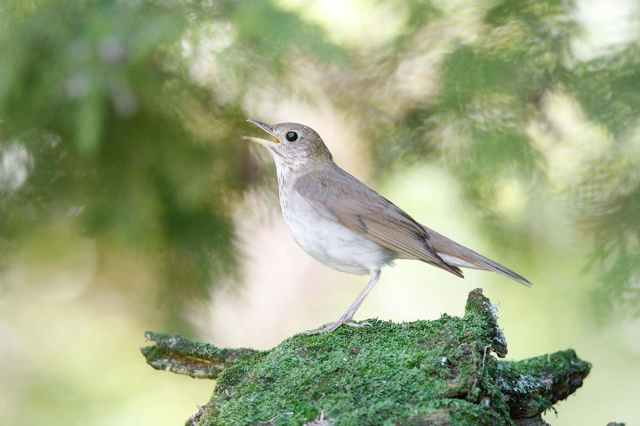
William Leaman/Alamy Stock Photo
It don’t mean a thing if it ain’t got that swing, goes the Duke Ellington song. By that logic, some bird songs really do mean something: at least a few bird species can swing in the same way that human musicians do, New Scientist can reveal.
This claim has been made based on a mathematical analysis of the songs of one species, the thrush nightingale. Not all of the musicians New Scientist spoke to agree that what the thrush nightingale is doing can be called swing – but several said they have heard other species of birds singing that definitely do swing.
The most swinging birdsong of all is that of the veery thrush of North America, says musician and author David Rothenberg of the New Jersey Institute of Technology. This is hard to hear at normal speed, but when the veery’s song is slowed down you can spot how it sings a long note followed by a short one, and then repeats this pattern.
Here’s the veery at normal speed:
And slowed down:
“It’s like a Miles Davis trumpet solo,” says Rothenberg.
Off the beat
In the narrowest sense, swing means delaying the off-beat, says jazz composer and drummer Stuart Brown. This means pairs of notes are played long-short instead of being of equal duration. Dum dum dum dum becomes dum-da, dum-da.
This kind of swing is typical of jazz and related styles of music developed in the early 20th century, but it was also used by some 17th-century musicians (“notes inégales”).
Swing is also used in a much broader sense to describe music that has a swinging feel, which it can have even if the off-beat is not delayed. “It’s this quality of unevenness that is so hard to quantify,” says Rothenberg. “You have to feel it.”
Or as jazz pianist Fats Waller is said to have put it: “If you gotta ask, you’ll never know.”[…]

 msamba