
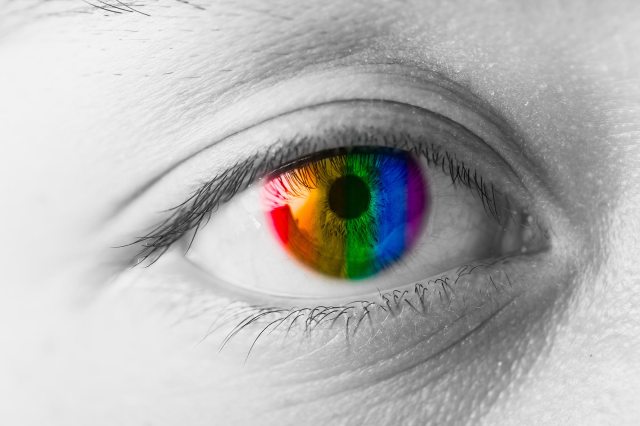
Researchers apply metasurfaces to standard contact lenses for customizable color correction.
Researchers have incorporated ultra-thin optical devices known as metasurfaces into off-the-shelf contact lenses to correct deuteranomaly, a form of red-green color blindness. The new customizable contact lens could offer a convenient and comfortable way to help people who experience various forms of color blindness.
“Problems with distinguishing red from green interrupt simple daily routines such as deciding whether a banana is ripe,” said Sharon Karepov from Tel Aviv University in Israel, a member of the research team. “Our contact lenses use metasurfaces based on nano-metric size gold ellipses to create a customized, compact and durable way to address these deficiencies.”
In The Optical Society (OSA) journal Optics Letters, Karepov and colleagues report that, based on simulations of color vision deficiency, their new metasurface-based contact lens can restore lost color contrast and improve color perception up to a factor of 10.
These images illustrate the effect a metasurface-based contact lens would have on a person with deuteranomaly. The left image shows the original scenario while the middle image is how the scene would look to a person with deuteranomaly. The image on the right represents the scene viewed with deuteranomaly and corrected with the new contact lenses. Credit: Sharon Karepov, Tel Aviv University
The approach used to introduce new and tailor-designed functionalities to contact lenses could be expanded to help other forms of color vision deficiency and even other eye disorders, according to the researchers.
Customized correction
Deuteranomaly, which occurs mostly in men, is a condition in which the photoreceptor responsible for detecting green light responds to light associated with redder colors. Scientists have known for more than 100 years that this vision problem can be improved by reducing detection of the excessively perceived color but achieving this correction in a comfortable and compact device is challenging.
“Glasses based on this correction concept are commercially available, however, they are significantly bulkier than contact lenses,” said Karepov. “Because the proposed optical element is ultrathin and can be embedded into any rigid contact lens, both deuteranomaly and other vision disorders such as refractive errors can be treated within a single contact lens.”
To solve this problem, the researchers turned to metasurfaces — artificially fabricated thin films designed with specific optical properties. Metasurfaces made of nanoscale gold ellipses have been extensively studied in the past few decades and can be designed to achieve specific effects on the light transmitted through them. However, the researchers needed a way to get metasurfaces, which are conventionally made on flat surfaces, onto the curved surfaces of contact lenses.[…]

 msamba