
 This is a huge win for the planet.
By Jessica Stewart on April 29, 2020
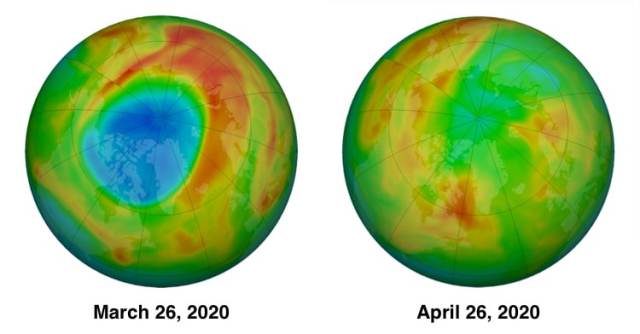
In a victory for the planet, a large hole in the ozone layer has closed up on its own. Located over the Arctic, it first formed in mid to late March and was one of the largest ozone holes the area had ever seen. As the ozone is responsible for absorbing the sun’s UV rays, its health is of the utmost importance to our planet. That’s what makes the hole’s closure such a relief.
To be clear, the hole’s appearance and repair were not caused by human activity. Scientists from Copernicus Atmosphere Monitoring Service (CAMS), who have been monitoring the area, attribute the ozone hole to something more natural. A large low-pressure area made from swirling cold air—known as a polar vortex—was particularly strong for several weeks in March. This caused cold air to remain trapped in the North Pole, the by-product of which was the formation of high altitude clouds that cause chemical reactions to stimulate ozone depletion once sunlight returns.
So, now that the polar vortex is starting to break down, the air between the ozone-depleted and ozone-rich layers are mixing once again. This has caused the hole to heal itself as ozone levels begin to rise once again.[…]
The unprecedented 2020 northern hemisphere #OzoneHole has come to an end. The #PolarVortex split, allowing #ozone-rich air into the Arctic, closely matching last week's forecast from the #CopernicusAtmosphere Monitoring Service.
More on the NH Ozone hole➡️https://t.co/Nf6AfjaYRi pic.twitter.com/qVPu70ycn4
— Copernicus ECMWF (@CopernicusECMWF) April 23, 2020
https://platform.twitter.com/widgets.jsMore: Large Hole in the Arctic Ozone Layer Is Now Closed

 msamba