
Sometimes having a visual is the best way to understand something. This is particularly true when it comes to science. And as wearing a face mask has become part of our daily routine, more and more people are questioning if it really matters. As summer sets in and heats up, how much will wearing another layer across your face really protect you? One microbiologist took matters into his own hands to show just what happens when you stay covered up.
Dr. Richard Davis is the Clinical Microbiology Lab Director at Providence Sacred Heart Medical Center in Spokane, Washington. After seeing a lot of misinformation about the dangers and usefulness of face masks, he decided to do a demonstration.
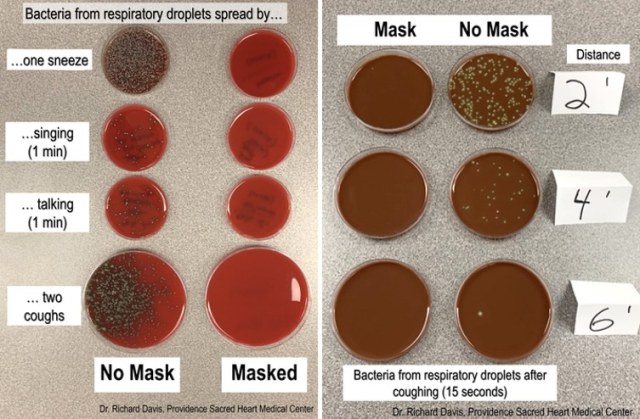
In the first demo, he placed agar cultures close to his face to show how many respiratory particles transferred while talking, singing, sneezing, and coughing with and without a face mask. The results are clear. Just one sneeze without a mask fills the culture with bacteria colonies that form where the respiratory droplets fell. Coughing gave a similar effect and even singing and talking for one minute caused bacteria transfer. Meanwhile, the masked cultures were basically clean.
For the second demonstration, Dr. Davis looked at distance, as this is the other common method of keeping the coronavirus from spreading. Placing bacteria culture plates two, four, and six feet away, he coughed hard for about 15 seconds both with and without a mask. Again, the results are clearly in favor of a face mask. While most droplets hit the plate when he was less than six feet away, a face mask blocked nearly all of them—no matter the distance.
So, it looks like face masks are two for two. Of course, Davis reminds us that these demonstrations do not show the spread of viruses like COVID-19. “Bacteria are incredibly different from viruses! But since we expect respiratory droplets to be what primarily spreads #COVID19, I exploit the presence of (easily to grow and visualize) bacteria in respiratory droplets, to show where they go,” he explains.[…]
Continue reading: Microbiologist Does Simple Demo to Show How Face Masks Are Effective

 msamba