
By Simi Jolaoso
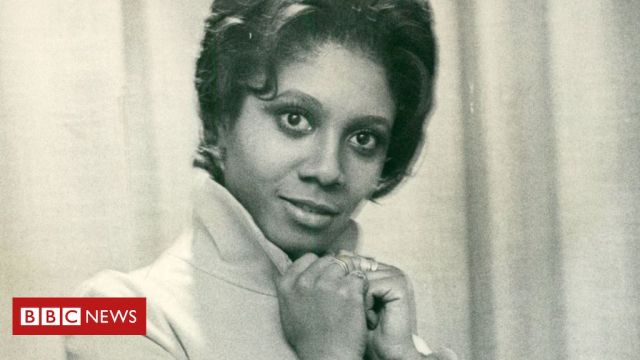
When British TV got its first black reporter in 1968 some viewers strongly objected and she was sacked in less than a year. Now, half a century later, a British Journalism Award has been named in her honour. Looking back, how does Barbara Blake Hannah feel about the way the country treated her?
“Too many times you buy a sandwich that you later realise had been spat in, or you’re walking down the street and are spat at yourself, or best case scenario, are told ‘[N-word] go home.’
“But when I roamed the streets as a reporter with a camera, no-one cared that I was black. They just cared about being on TV, that’s one reason why I loved the job.”
Barbara Blake Hannah was 24 when she first arrived in the UK to work as an extra on the 1965 movie, A High Wind in Jamaica. And when filming finished, she and a friend decided to stay.
“Britain seemed to be opening up with opportunities at that time. I was young, living in London during the swinging 60s. It was all so exciting,” she says.

She had plenty of journalism experience from Jamaica, having read the news on TV and written for a magazine owned by her father, Evon Blake, the founder of Jamaica’s Press Association.
But despite this, it wasn’t easy to get a job in the industry. She had to settle for temporary secretarial work “using shorthand and typing skills from training as a journalist”, but she didn’t stop applying for writing jobs, and eventually broke through.
In 1966, Barbara noticed the Sunday Times magazine was running a series on food around the world, so she got in touch and offered to write something on Jamaican cooking. “I was given a nice colourful page feature in my Jamaican costume,” she says.
This was followed by a number of other plum assignments, including interviewing the A-list entertainer Sammy Davis Jr – the only black member of Frank Sinatra’s Rat Pack – and Jacqueline Susann, author of a 1966 blockbuster novel, Valley of the Dolls, whom Barbara describes as “fabulous, a real superstar, like something out of Dynasty”.
Barbara also wrote for the now defunct West Indian World and Caribbean Times newspapers, and for Cosmopolitan and Queen Magazine.
“It was great to be a young journalist again. I made friends with other writers, we’d go out and about on Fleet Street. There was the Beatles, Jimmy Hendrix, the anti-war-in-Vietnam movement, the play Hair, the Supremes, Tom Jones, Cilla Black… It was fantastic.”

During the summer of 1968, Barbara heard about the launch of Thames Television. In true go-getter fashion, she wrote to them asking for a job, and was asked to audition.
“I was the most interesting, I could write a good script and I made them laugh,” she says. Her impressive French and Spanish skills, which she’d learnt at boarding school in Kingston, didn’t go unnoticed either. She was immediately offered a contract on the daily evening show, Today, hosted by Eamonn Andrews.
But a black woman reporting the news was unheard of. This was five years before the UK was introduced to ITN’s first black reporter, Trevor McDonald, and more than a decade before the arrival of the BBC’s Moira Stewart.
The Times newspaper did a full-page spread on Barbara’s debut, but she wasn’t fazed.
“To me, it was just another job. I would get briefed in the newsroom, go out to film, come back to edit and be in the studio. I had already gone through the jitters of being on TV during my time in Jamaica, it was just really nice to be able to do what I enjoyed.
“I wasn’t famous like Twiggy, but I guess I was known by a few. It’s only nowadays I hear from people who say they or their parents watched me back then.”
 Barbara Blake Hannah (right) in a Biba dress, with Eamonn Andrews and fellow reporter Jane Probyn
Barbara reported on it all, from crime stories to the closure of the Beatles’ Baker Street shop, often called the Apple Boutique. She interviewed Sir Michael Caine, round-the-world sailor Sir Frances Chichester, and the “great beauty”, Bianca Jagger.
“Eamonn Andrews, though he was famous, was a lovely man and genial host. My colleagues didn’t treat me differently because I was black. In the office, I was just treated as another worker. It was a really great show to be on.”
However, nine months into her role, Barbara’s time at Thames Television came to a sudden end. Her journalistic skills and warm on-screen presence did not impress some viewers who could not see past the colour of her skin. A producer told Barbara that the station had received almost daily requests to “get the [N-word] off the screen”, and so they did.
“It was the most hurtful thing that happened to me because I was black, and trust me, a lot of things happened to me,” she says.
“It was almost as if I had been found to have a communicable disease. I had been so excited to get this job, and now I had to tell my friends I no longer had it, just because I was black. I hid myself in shame for a long time.
“I didn’t receive any compensation, an apology, nothing. I didn’t think of even asking for one, we black people weren’t protected [against discrimination] in the workplace – maybe later on paper, but definitely not in the practical sense.
“But you know what, even just an apology would be nice, 50 years later.”
Thames Television ceased to exist in 2003.[…]
Continue reading: Barbara Blake Hannah: The first black reporter on British TV

 msamba
It is hard for me to realize that people in the sixties still were so extremely racist, I mean what she experienced can’t be called subtle, can it. Sometimes I feel that I have lived in a bubble when I was young.
LikeLiked by 1 person
Here in England those attitudes were normal and ubiquitous back then, and are still held by some people (judging by reactions to Black Lives Matter on Twitter). We have come a long way recently but still have some way to go…
LikeLiked by 1 person