
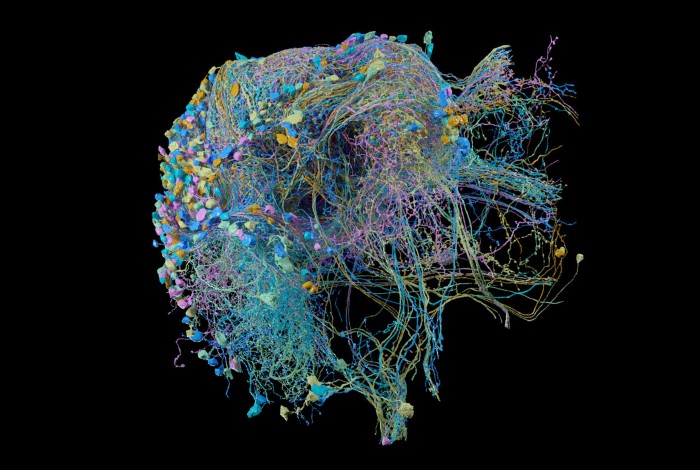
 Tracing connections, such as those in this section of the fruit-fly brain, could uncover links between neural architecture, biology and disease. Credit: FlyEM at HHMI/Google Research
Artificial intelligence and improved microscopy make it feasible to map the nervous system at ever-higher resolution.
There are 70 million neurons in the mouse brain, and Moritz Helmstaedter wants to map them all. He was a medical student at Heidelberg University in Germany when psychiatrists there suggested that some aspects of the human psyche lack a biological explanation. “I was totally appalled,” recalls Helmstaedter, who is now a director at the Max Planck Institute for Brain Research in Frankfurt, Germany.
Although the brain remains a mystery, Helmstaedter was convinced that what goes on there “must be a mechanistic phenomenon in the end, as complex as it may be”. He has dedicated the past two decades to working those mechanisms out — and he and other neuroscientists are finally starting to scratch the surface, one cubic micrometre at a time.
Starting in the 1970s, it took more than a decade to unravel the neural circuitry of the one-millimetre worm, Caenorhabditis elegans. Probing the relationship between genes and behaviour, biologist Sydney Brenner and his colleagues at the MRC Laboratory of Molecular Biology in Cambridge, UK, laboriously traced the fine branches and synaptic connections of each nerve cell, colour-coding them by hand on thousands of electron-micrograph prints. That wiring map — the first and only complete set of synaptic connections in an animal’s nervous system — was stored on a room-sized computer and published1 as the first full animal ‘connectome’ in a 340-page opus in 1986.
Caenorhabditis elegans has fewer than 400 neurons; human brains have 86 billion. So for now, scientists are eyeing an intermediate milestone: mapping the fine-scale neural circuitry of the mouse2.
Even with about 1,000-fold fewer cells, the mouse brain poses a formidable challenge, says Jeff Lichtman, a neuroscientist at Harvard University in Cambridge, Massachusetts, who is one of the leaders of a global consortium that aims to reconstruct the neural wiring of a mouse brain over the next decade. “We’re dealing with a data set that will be on the scale of an exabyte.” An exabyte is one billion gigabytes; the entire human genome can be represented in about 1.5 gigabytes. In terms of data size, mapping the mouse brain connectome will be “enormous compared to anything that’s been done as a single project”, he says. “Connectomes are just magnificently complicated.”
Yet the technology to make such an undertaking possible is nearly there. With advances in microscopy and artificial intelligence (AI), and crowdsourced help from human gamers, researchers are beginning to map neural networks and their connections at ever-higher resolution and scale. Over the past several years, small bits of brain, including pieces of the mammalian retina and cerebral cortex, have come into focus. And in September, researchers working on Drosophila fruit flies reported3 the largest reconstruction so far: 25,000 neurons in the hemibrain, a cube of tissue measuring 250 micrometres on a side and representing 40% of the fly’s brain.[…]
Continue reading: Probing fine-scale connections in the brain

 msamba