
GRACE EBERT
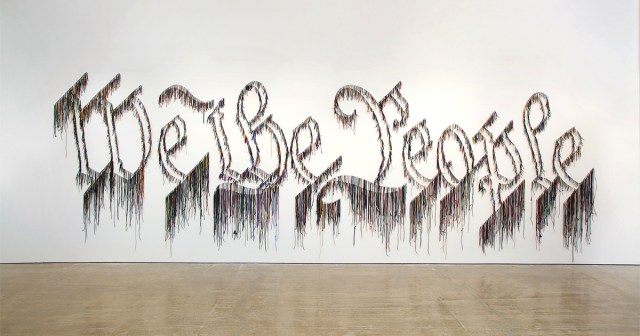 “We the People” (2011), shoelaces, 96 x 324 inches. All images courtesy Nari Ward and Lehmann Maupin, New York, Hong Kong, Seoul, and London
Jamaica-born artist Nari Ward bases his practice in found objects and their inherent mutability. The Harlem-based artist has scoured New York City’s streets for 25 years gathering house keys escaped from a ring, discarded glass bottles, and clothing tossed season-to-season. Through sculptures and large-scale installations, the scavenged objects find new meaning, whether explicitly scribing a phrase from the United States Constitution or creating more subtle historical connections.
While commenting broadly on themes of race, poverty, and rampant consumerism, Ward is cognizant of the varied meanings burned wooden bats or shoelaces hold for different populations. No matter the medium, many of his works are site-specific in form and fluid in context, allowing the narratives to take new shapes as they travel from community to community.
His 1993 installation “Amazing Grace,” for example, originally was presented in Harlem in response to the AIDS crisis. The artist gathered lengths of fire hose and approximately 300 baby strollers to line the space’s perimeter, with some piled in a central area, as well. In New York City, houseless populations sometimes use the childcare item to carry their belongings, imbuing the objects with a specific message within that milieu. When “Amazing Grace” later traveled around Europe, the strollers were interpreted anew.
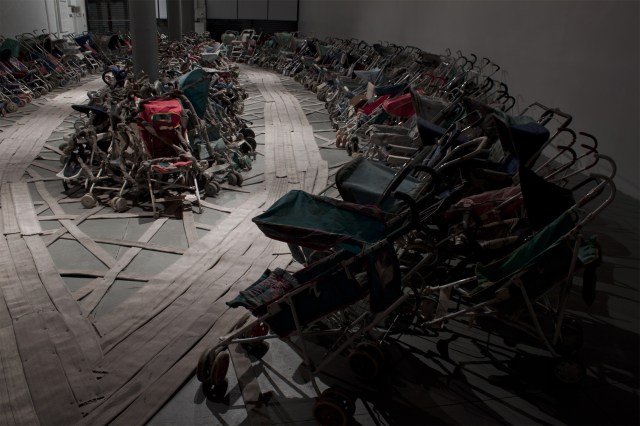 “Amazing Grace” (1993), approximately 300 baby strollers and fires hoses, sound, dimensions variable. Installation view, New Museum, New York (2019)
In a 2019 interview, Ward expanded on the inherent fluctuations within the symbols and objects he employs:
History tells a particular story, and I’m trying to say: ‘Yeah there is a particular story, but there are many stories that aren’t visible within that one created narrative.’ I think that it’s about bringing mystery into the conversation more so than facts. So the whole idea is bringing this marker, image, or form to the forefront, but at the same time destabilizing it so that it acts as a placeholder for other possibilities or somebody else’s narrative.
[…]
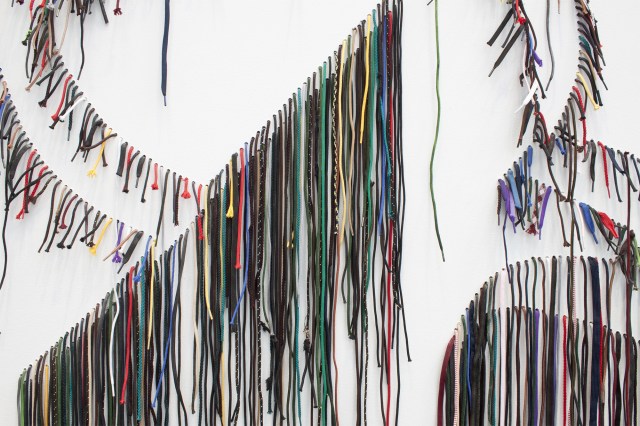 “We the People” (2011), (detail), shoelaces, 96 x 324 inches
See more: Artist Nari Ward Has Spent Decades Revitalizing Found Objects to Elucidate Counter Narratives

 msamba