
Data haul from Gaia space observatory offers a glimpse of what Earth’s night sky will look like for 1.6 million years to come.
DETAILS

- Video Online only
- Title Gaia’s stellar motion for the next 1.6 million years
- Released: 03/12/2020
- Length 00:00:45
- Language English
- Footage Type Animation
- Copyright ESA/Gaia/DPAC; CC BY-SA 3.0 IGO. Acknowledgement: A. Brown, S. Jordan, T. Roegiers, X. Luri, E. Masana, T. Prusti and A. Moitinho.
- DescriptionThe stars are constantly moving across the sky. Known as proper motion, this motion is imperceptible to the unaided eye but is being measured with increasing precision by Gaia. This animation shows the proper motions of 40 000 stars, all located within 100 parsecs (326 light years) of the Solar System. The animation begins with the stars in their current positions; the brightness of each dot representing the brightness of the star it represents.
As the animation begins, the trails grow, showing how the stars will change position over the next 80,000 years. Short trails indicate that the star is moving more slowly across the sky, whereas long trails indicate faster motion. To avoid the animation becoming too difficult to interpret, the oldest parts of the trails are erased to only show the newer parts of the stellar motions into the future.
Sometimes it appears as if a star is accelerating (as indicated by a longer trail). This is due to the star getting closer to us. Proper motion is a measure of angular velocity, which means that close-by stars appear to move more quicker across the sky even when their speed is the same as that of other, more distant stars.
Towards the end of the animation, the stars appear to congregate on the right side of the image, leaving the left side emptier. This is an artefact and is caused by the average motion of the Solar System with respect to the surrounding stars.
The animation ends by showing star trails for 400 thousand years into the future.

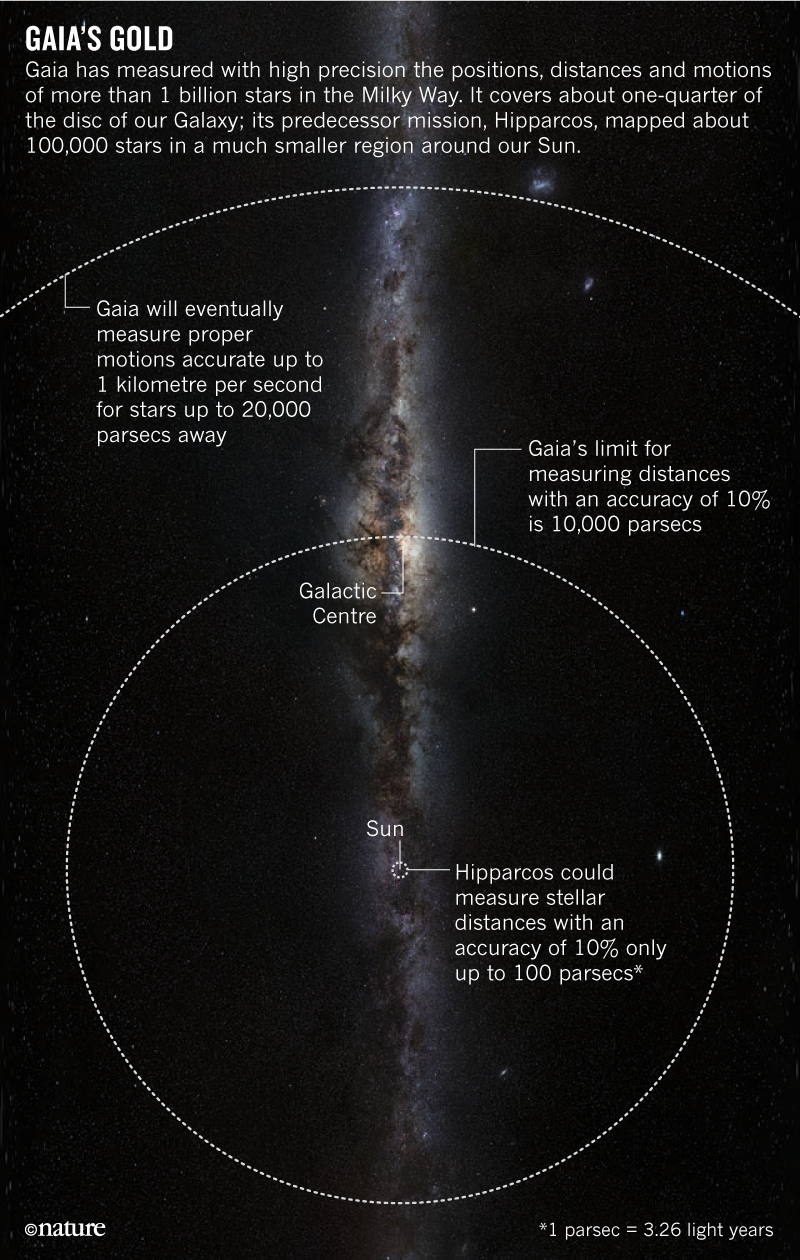
The best available map of the Milky Way just got better. The latest update from the Gaia space observatory — which is tracking more than 1 billion stars in the Galaxy — provides not just a static image but a picture of how stars will move over time. The data will underpin studies that range from the origins and evolution of the Galaxy to locating its dark matter.
“I am yet to see another project in astronomy — or any science — that has had such an impact on such a short timescale,” says Amina Helmi, an astronomer at the University of Groningen in the Netherlands. “My group is ready to go and very excited to find out what is there to discover and learn about the Milky Way.” Using data that Gaia released in 2018, Helmi and her collaborators have studied the motions of large numbers of stars to reveal evidence of galactic mergers that happened billions of years in the past.
Gaia lifted off in late 2013, and began observing stars in July 2014 from a perch 1.5 million kilometres from Earth. The European Space Agency (ESA) probe continuously scans the sky as it slowly spins on itself, and it has now measured the positions of the same stars multiple times. This enables scientists to track stars’ nearly imperceptible motions across the Galaxy year after year. As Gaia orbits the Sun, its changing perspective also makes the stars’ apparent position change by tiny amounts — typically by an angle of millionths of a degree. These offsets can be used to calculate their distance from our Solar System using a technique called parallax.
The type of information Gaia provides is the bread and butter of the field. Without a reliable distance measurement, in particular, it can be difficult to guess a star’s size, age and brightness, and therefore to model its structure and evolution.
Researchers have pored over the mission’s two previous data sets, released in 2016 and 2018. Those are now being cited in the literature at a rate of 3,000 times per year, according to Floor van Leeuwen, an astronomer at the University of Cambridge, UK. One website has catalogued 4,324 refereed papers based on Gaia data so far. “You can see the influence of Gaia data spreading through all of astronomy,” he says.[…]

More: Best map of Milky Way reveals a billion stars in motion

 msamba