
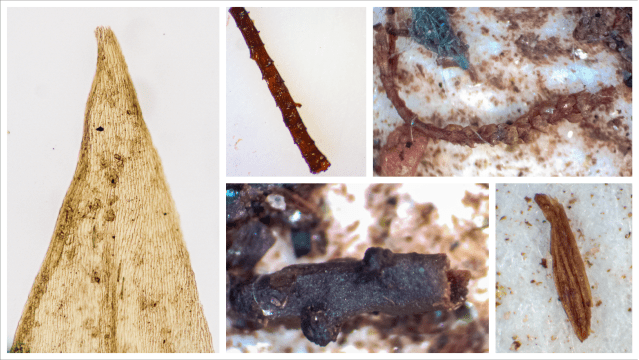
 This ancient ecosystem showed that the ice sheet had melted to the ground in northern Greenland within the past million years.
In 1963, inside a covert U.S. military base in northern Greenland, a team of scientists began drilling down through the Greenland ice sheet. Piece by piece, they extracted an ice core 4 inches across and nearly a mile long. At the very end, they pulled up something else – 12 feet of frozen soil.
The ice told a story of Earth’s climate history. The frozen soil was examined, set aside and then forgotten.
Half a century later, scientists rediscovered that soil in a Danish freezer. It is now revealing its secrets.
Using lab techniques unimaginable in the 1960s when the core was drilled, we and an international team of fellow scientists were able to show that Greenland’s massive ice sheet had melted to the ground there within the past million years. Radiocarbon dating shows that it would have happened more than 50,000 years ago. It most likely happened during times when the climate was warm and sea level was high, possibly 400,000 years ago.
And there was more. As we explored the soil under a microscope, we were stunned to discover the remnants of a tundra ecosystem – twigs, leaves and moss. We were looking at northern Greenland as it existed the last time the region was ice-free. Our peer-reviewed study was published on March 15 in Proceedings of the National Academy of Sciences.
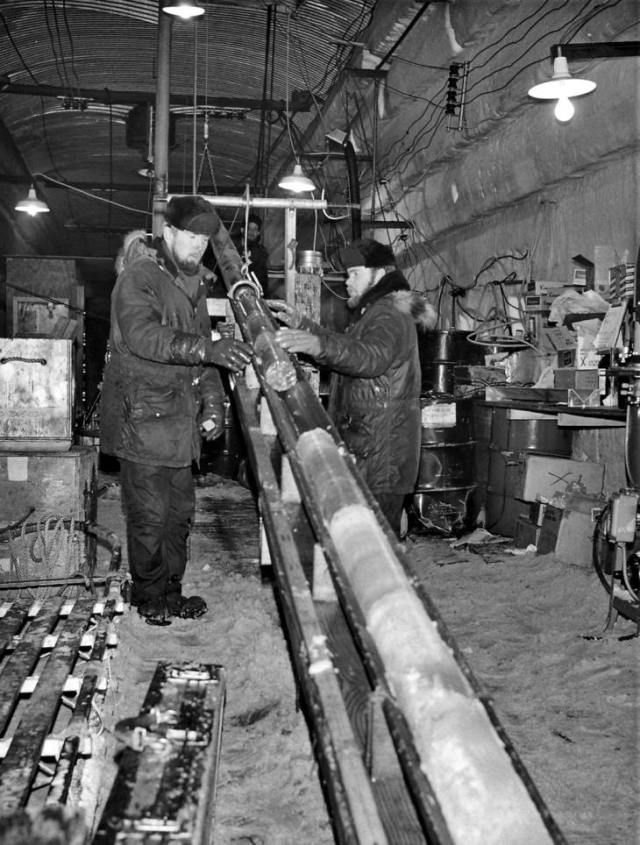 Engineers pull up a section of the 4,560-foot-long ice core at Camp Century in the 1960s. U.S. Army Corps of Engineers
Paul Bierman, a geomorphologist and geochemist, describes what he and his colleagues found in the soil
With no ice sheet, sunlight would have warmed the soil enough for tundra vegetation to cover the landscape. The oceans around the globe would have been more than 10 feet higher, and maybe even 20 feet. The land on which Boston, London and Shanghai sit today would have been under the ocean waves.
All of this happened before humans began warming the Earth’s climate. The atmosphere at that time contained far less carbon dioxide than it does today, and it wasn’t rising as quickly. The ice core and the soil below are something of a Rosetta Stone for understanding how durable the Greenland ice sheet has been during past warm periods – and how quickly it might melt again as the climate heats up.
Secret military bases and Danish freezers
The story of the ice core begins during the Cold War with a military mission dubbed Project Iceworm. Starting around 1959, the U.S. Army hauled hundreds of soldiers, heavy equipment and even a nuclear reactor across the ice sheet in northwest Greenland and dug a base of tunnels inside the ice. They called it Camp Century.
It was part of a secret plan to hide nuclear weapons from the Soviets.[…]
Continue reading: Ancient leaves preserved under a mile of Greenland’s ice – and lost in a freezer for years – hold lessons about climate change

 msamba