
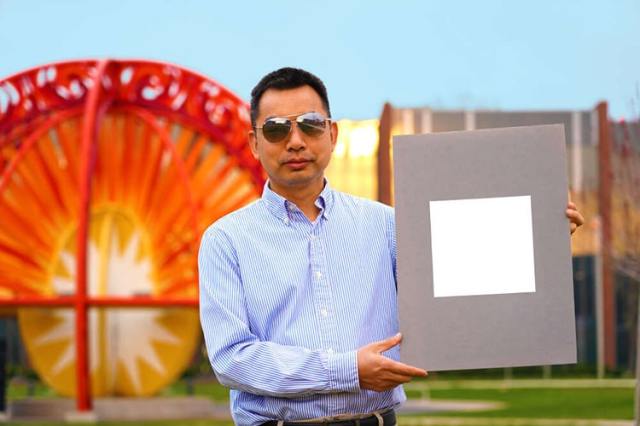
 Professor Xiulin Ruan with a sample of the whitest paint yet developed. (Photo: Jared Pike/Purdue University)
“Painting 0.5-1% of the Earth’s surface (roofs, roads, cars, unused land, etc) with our paint will stop the warming trend.”
Combatting the rise in global temperatures requires creative science and innovative thinking. An exciting, new development was recently announced in the journal ACS Applied Materials & Interfaces by an engineering and nanotechnology team at Purdue University. The team created an ultra-white paint—the whitest to date—which promises a powerful cooling effect that could help combat the use of air conditioning units which contribute to climate change.
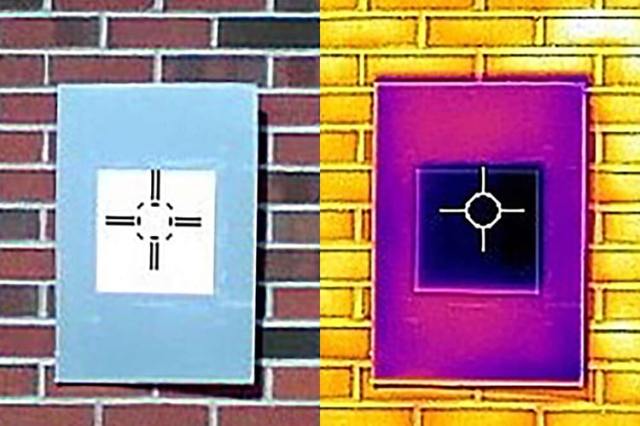 Infrared images showing how the ultrawhite paint actually has a cooling effect. The purple is ambient temperature, the black represents the cooler painted swatch. (Photo: Joseph Peoples/Purdue University)
Scientists had previously discovered a white paint that reflects 95.5% of light. This paint was based on calcium carbonate (CaCO3), which is found in chalk. While the darkest black (vantablack) absorbs 99.95% of light waves, the brightest white should reflect the maximum light possible. The announcement of a new formula for ultra-white is another step in this quest. Based on a high concentration of the pigment barium sulphate, the new paint reflects 98.1% of sunlight. Barium sulphate also reflects UV light. As a result, the paint bounces light and heat right back to deep space in the form of radiation (waves) which travel through our atmosphere without being absorbed. […]
Read more: Whitest Paint Ever Developed Could Help Slow Global Warming

 msamba