
MIGUEL ÁNGEL CRIADO
OCT 25, 2022 – 12:42 GMT+
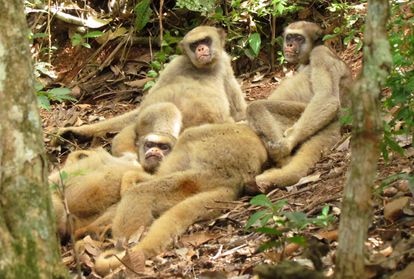
40 years ago muriquis spent just 0.05% of their time on the ground, a percentage that has increased twentyfold in a quarter of a century.
MARLON LIMA / PROJETO MURIQUI DE CARATINGA
Climate change, deforestation and the extermination of predators are leading arboreal primates to spend more time on the ground
The northern muriqui monkey is born, lives and dies in the trees. These monkeys, once abundant in the dwindling Atlantic Forest of eastern Brazil, eat, socialize, play and reproduce without ever descending to the ground. They only leave their arboreal safety in emergency situations (when a baby falls to the ground, for example) or if they are being chased by a predator. But in the Feliciano Miguel Abdala Private Natural Heritage Reserve, in the state of Minas Gerais, there have been no dangerous predators for a long time. Perhaps this explains why for at least four decades they have been increasingly seen coming down from the trees. At first it was for feeding and little else, but now they spend almost half of their time on the ground, resting and frolicking. This is not an isolated case; it is taking place across the Americas, Africa and Asia.
Primatologists have been studying the Feliciano Miguel Abdala muriquis since the 1970s. This species of spider monkey is on the verge of extinction; there are fewer than 1,000 specimens remaining in the wild and it is classified as “critically endangered” on the International Union for Conservation of Nature’s Red List of Threatened Species. The decline of their natural habitat, the Brazilian Atlantic Forest, has confined them to patches of jungle surrounded by farmland, grazing pastures and forest plots. The upside of so much human pressure is that their natural predators have become extinct; the downside is that their refuge does not surpass 1,000 hectares.
The combination of both factors could explain a phenomenon that began as sporadic but is now a tradition passed down through generations: spending more time on the ground. Scientists first witnessed a muriqui descending from a tree in 1982. They did not see it as hugely significant at the time but they did write it down, as they do with everything they see, either directly or through dozens of cameras installed throughout the forest. With more than 10,000 observations over three years, they estimated 40 years ago that muriquis spent just 0.05% of their time on the ground. In another study conducted between 1998 and 1999, it had increased to 0.7%. In another investigation carried out between 2006 and 2007, with almost 15,000 observations, the percentage had risen to 1%. It doesn’t sound like much, but it represents a twentyfold increase in just a quarter of a century. The data from the most recent campaign is still being analyzed.
The forested margins impose limits to the expansion of the distribution areas, so the only solution was to expand the use of vertical space”Karen Strier, primatóloga de la Universidad Wisconsin-Madison (Estados Unidos)
Karen Strier, a primatologist at the University of Wisconsin-Madison, has been studying the muriquis of the Feliciano Miguel Abdala reserve and other groups still present in the region since 1982. These primates are not only interesting because of their critical situation; being patrilineal and patrilocal, with females coming from outside the group, there is hardly any hierarchy between the sexes and within each gender, which makes it a very egalitarian society, which is rare among primates. For Strier, the increase in visits to the ground is closely related to the rise in demographic pressure in an increasingly reduced space. Time spent on the ground extended, she explains, as the population of muriquis rose to what the scientists suspected could have been a threshold. The forest boundaries of the Feliciano Miguel Abdala reserve impose limits on the expansion of the distribution areas, so the only solution was to make the most out of the vertical space. This is what muriquis, as well as other arboreal primates, are being forced to do.[…]
Continue reading: Why are the monkeys descending from the trees?


