
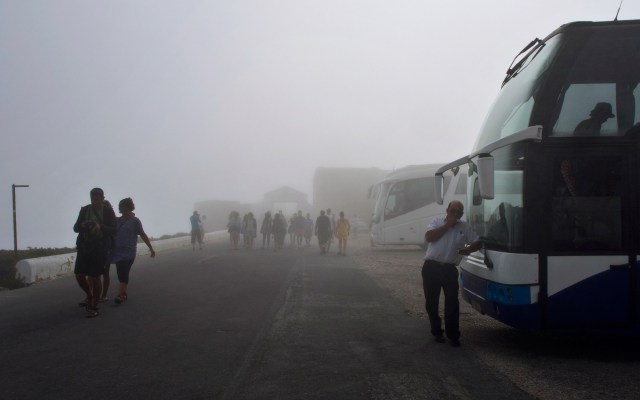
 ape St Vincent, Portugal, 2012. Photo by Alfredo D’Amato/Panos
In the face of an inscrutable, indifferent universe, Pessoa suggests we cultivate a certain longing for the elusive horizon
An elusive point sits on the horizon. A deep yearning stirs within to move closer to this point, perhaps in search of the unknown, perhaps in search of questions without answers. It is a yearning that will never be fulfilled. It is a point never reached. This yearning is the all-too-human inclination for our lives to somehow be different than they are, and for the universe not to be indifferent to our cares and concerns.
In her essay ‘The Blue of Distance’ (2005), the US author Rebecca Solnit associates this point never-reached with the colour blue. She writes:
For many years, I have been moved by the blue at the far edge of what can be seen, that color of horizons, of remote mountain ranges, of anything far away. The color of that distance is the color of an emotion, the color of solitude and of desire, the color of there seen from here, the color of where you are not. And the color of where you can never go.
When combined with the longing for something absent, for something that simply can’t be, this is saudade, a Portuguese expression for a state akin to melancholic longing. A complex emotion where a melancholic grey seeps into the distant blue.
Lacking any easy English translation, saudade seems to be an emotion that can be expressed only through poetry or other evocations of its melancholic longing. Whereas nostalgia is a longing for something that once existed, a person or place or experience that lives in our memory, saudade encompasses a longing for something that never was, something not attainable.
Within the yearning, a sense of incompleteness exists, a feeling of loss for something we never actually had. We want, for example, to connect to the divine, to the universe, in a personal and meaningful way. We long to find meaning in our existence and our experiences – and the meaning we tend to attach to the confusion and loss we feel when this fails to happen is of some sort of providential punishment or karmic backlash. No matter how we attempt to make sense of what we experience, the indifference lingers, an unsettling realisation that nothing, ultimately, matters. We long for the things we do and say to make a difference, for the universe to respond to our call in a way that is just and kind. But it simply can’t.
How can we still find solace living in such a world, where indifference is all there is, to reach a place where our yearning has not disappeared but yet has, in some way, been transformed?
n her essay ‘“Saudade” and “Soledad”: Fernando Pessoa and Antonio Machado on Nostalgia and Loneliness’ (2007), the Lusophone scholar Estela Vieira provides a possible solution. She writes:
‘Saudade’ in Pessoa is a lot more related to loneliness since the absence of others is what causes the painful feelings regularly associated with nostalgia. Yet the absence is itself a creative presence populated with imagined others a lot more real than the emptiness of reality. Like all feelings, loneliness for him is nothing more than one of the sources of creation.
Fernando Pessoa (1888-1935) lived what was in many ways an astonishingly modern, transcultural and translingual life. He was born in Lisbon, the point of departure for Vasco da Gama’s voyage to India as commemorated by Pessoa’s forebear, the poet Luís de Camões. Pessoa grew up in Anglophone Durban in South Africa, acquiring a life-long love for English poetry and language. Returning to Lisbon in 1905, which he would never again leave, Pessoa set himself the goal to travel throughout an infinitude of inner landscapes, to be an explorer of innerworlds.
He published very little during his lifetime but left behind a renowned trunk containing a treasure trove of scraps, on which were written some of the greatest literary works of the 20th century, mainly in Portuguese but also substantially in English and French. Pessoa wrote poems under a variety of heteronyms, the ‘virtual subjects’ of his imagination; and also, importantly, a novel, or rather the anti-novel, The Book of Disquiet (1982), whose protagonist, Bernardo Soares, ruminates in detail on the meaning of being.
Vieira’s interesting idea is to fashion a link between saudade and Pessoa’s creation of a coterie of heteronyms, virtual other selves through which he could live a multiplicity of imagined lives. If saudade is a melancholic yearning for something the universe will never provide, perhaps the very absence to which it draws our attention can be a creative opportunity, an empty space that Pessoa seeks to fill, and the invention of heteronyms is his way to fill it.
If everything is unimportant, then all we do is unimportant too
And yet this doesn’t quite work. In The Book of Disquiet, for instance, Pessoa has his novel’s putative protagonist Soares – the literary vehicle through which he explores the idea of saudade – say:
What I confess is unimportant, because everything is unimportant.
– all quotes are from the Richard Zenith translation of The Book of Disquiet(2002)
The indifference of the universe is not, then, a creative opportunity but instead directly confronts us with the fact that nothing we might try to create is of any importance. If what Soares expresses here is true, we find no solace in inventing heteronyms, or anything else. If everything is unimportant, then all we do is unimportant too. This is only to reinforce the sentiment Soares expresses earlier in the same passage, saying:
These are my Confessions, and if in them I say nothing, it’s because I have nothing to say.
Pessoa isn’t finding solace in his creations, or even in his confessions, but in his acceptance of their unimportance, an acceptance that the universe is indifferent to anything he creates. In the voice of Soares, Pessoa himself says as much:
Ah, no nostalgia [saudade] hurts as much as nostalgia for things that never existed! The longing I feel when I think of the past I’ve lived in real time, when I weep over the corpse of my childhood life – this can’t compare to the fervour of my trembling grief as I weep over the non-reality of my dreams’ humble characters, even the minor ones I recall having seen just once in my pseudo-life, while turning a corner in my envisioned world, or while passing through a doorway on a street that I walked up and down in the same dream.
My bitterness over nostalgia’s [saudade] impotence to revive and resurrect becomes a tearful rage against God …
In saudade, which Zenith translates as ‘nostalgia’, our yearning then begins to take on a new kind of melancholy – one that takes away any kind of comfort we might have found in our attempts to seek connection with an indifferent universe, one in which the longed-for blue point on the horizon turns a blue-grey. Saudade is woven throughout Pessoa’s work. It reflects that he has found solace in the understanding that there is no meaning, that he has accepted everything as it is, an acceptance of the indifference of the universe. Pessoa has Soares say:
The inscrutability of the universe is quite enough for us to think about; to want to actually understand it is to be less than human, since to be human is to realise it can’t be understood.
Perhaps, then, the idea is that finding acceptance in indifference is a way to move closer to being fully human.
Rather than the sufferings of loneliness, it is more helpful here to think about the process of grieving. Moving through denial, anger, bargaining and depression can lead us, eventually, to an acceptance that we cannot change the one we have lost and that their absence is now a permanent feature of the universe we inhabit. We try so hard to deny the indifference of the universe by finding meaning in religion, spiritual practices or our experiences. When these meaning-making efforts stop making sense, then anger, bargaining and depression surface, sometimes all at once when the wave of shock at the world’s indifference subsides.
As we emerge on the other side of these emotions, a glimpse of hope appears in the form of acceptance. We can still yearn for something to fill the empty space in what feels like an incompleteness of life, but that yearning takes on a new purpose: it exposes a new humanness that before was obscured. The Dutch photographer Nanouk Prins is one who finds this connection between saudade and grief, and many of her photographs have a blue-grey tone.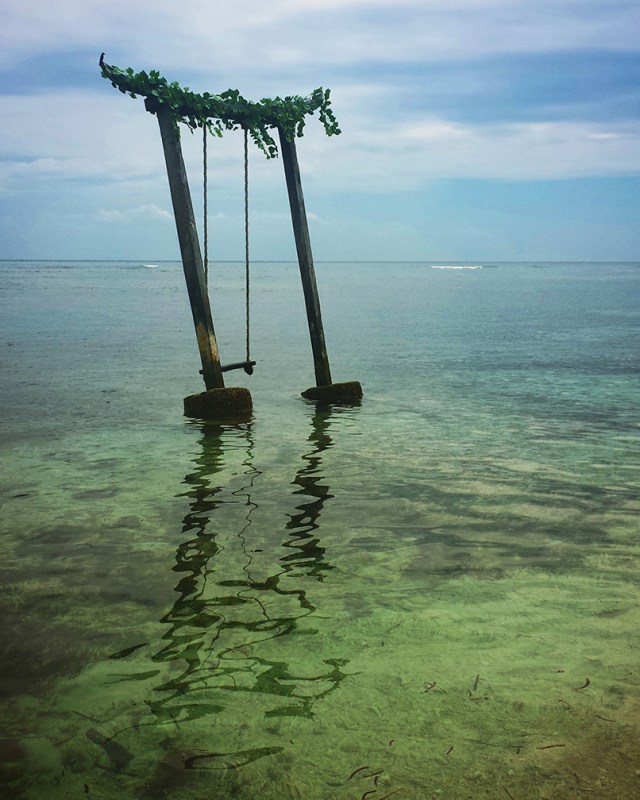 Photo by Sarah Seymour
Here is how Pessoa (as Soares) makes the link between grief and meaninglessness:
In these times of acute grief, it is impossible – even in dreams – to be a lover, to be a hero, to be happy. All of this is empty, even in our idea of what it is. It’s all spoken in another language that we can’t grasp – mere nonsense syllables to our understanding. Life is hollow, the soul hollow, the world hollow. All gods die a death greater than death. All is emptier than the void. All is a chaos of things that are nothing.
If, on thinking this, I look up to see if reality can quench my thirst, I see inexpressive façades, inexpressive faces, inexpressive gestures. Stones, bodies, ideas – all dead. All movements are one great standstill. Nothing means anything to me … And in the bottom of my soul – as the only reality of this moment – there’s an intense and invisible grief, a sadness like the sound of someone crying in a dark room.
In this movement of grief, Pessoa arrives at a self-awareness, an acceptance of the world’s inevitable insouciance. This allows him a kind of clarity to see the meaninglessness and inexpressiveness of everything. And it is within this clarity and stillness that solace is finally found. The longing hasn’t vanished but is now truly seen and accepted without giving it meaning or importance. He does not claim understanding, but instead embraces just how things are.
To find solace here without the yearning for meaning is to find stillness and to experience it as what it is to be fully human.[…]
Continue reading: How to find a strange solace in the indifference of the universe | Aeon Essays
Edited bySam Dresser

 msamba