
 oys at Kamloops Indian Residential School, probably before the 1920s. All photos courtesy the Indian Residential School History and Dialogue Centre at the University of British Columbia, except where noted
Thousands of Indigenous children suffered and died in residential ‘schools’ around the world. Their stories must be heard
Between 1890 and 1978, at Kamloops Indian Residential School in the Canadian province of British Columbia, thousands of Indigenous children were taught to ‘forget’. Separated from their families, these children were compelled to forget their languages, their identities and their cultures. Through separation and forgetting, settler governments and teachers believed they were not only helping Indigenous children, but the nation itself. Canada would make progress, settlers hoped, if Indigenous children could just be made more like white people.
In 1890, this curriculum of forgetting was forcibly taught in the few wooden classrooms and living quarters that comprised Kamloops Indian Residential School. But in the early 20th century, the institution expanded, and a complex of redbrick buildings was constructed to accommodate an increase in students. In every year of the 1950s, the total enrolment at the ‘school’ exceeded 500 Indigenous children, making this the largest institution of its kind in Canada. Plan of Kamloops Indian Residential School, 1917
 View of Kamloops Indian Residential School, date unknown
Today, the redbrick buildings are still standing on the Tk’emlúps te Secwépemc First Nation’s land. You can still look through the glass windows and see the old classrooms and halls. You can walk the grounds, toward the site of the former orchard or the banks of the nearby river. And you can stand over the graves of 215 children who died right here, at Kamloops Indian Residential School. Some never saw their fourth birthday.
You might think the Kamloops ‘school’ and its unmarked graves are an isolated and regrettable part of Canadian history, which we have now moved beyond. But that is a lie. Those 215 graves are part of a much larger political project that continues to this day.
hen the burial sites at Kamloops were identified in May 2021 using ground-penetrating radar, news of the ‘discovery’ spread through international media. First-hand accounts of former students and Indigenous community members began to spread, too, and it soon became clear to the wider world that the ‘discovery’ was really a confirmation of what Indigenous peoples in Canada had known for generations. As Rosanne Casimir, the current Kúkpi7 (chief) of Tk’emlúps te Secwépemc, explains it, the search for bodies was a deliberate attempt to verify a knowing:
We had a knowing in our community that we were able to verify. To our knowledge, these missing children are undocumented deaths … Some were as young as three years old. We sought out a way to confirm that knowing out of deepest respect and love for those lost children and their families, understanding that Tk’emlúps te Secwépemc is the final resting place of these children.
The testimonies from survivors and their descendants were met with expressions of shock and disbelief from settler Canadians: how could this have happened? Why didn’t we know anything about this? But the knowledge was no secret. It was publicly available in institutional records; it was in the testimonies of Indigenous peoples; and it was in 20th-century reports made by government officials. We didn’t just choose to forget, we participated in a grand project of forgetting.[…]
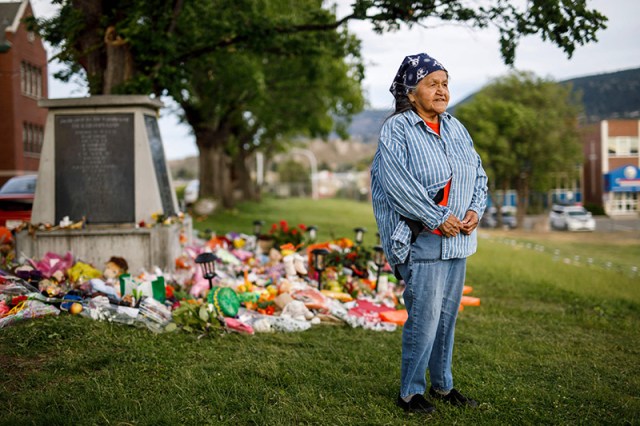 Evelyn Camille, 82, a survivor of Kamloops Indian Residential School, beside a memorial to the 215 children whose remains were discovered there; 4 June 2021. Photo by Cole Burston/AFP/Getty
is associate professor of applied and clinical psychology at the University of Plymouth, England.
Edited byCameron Allan McKean
6,000 words
Continue reading: We must not forget what happened to the world’s Indigenous children | Aeon Essays

 msamba