
By Elizabeth Beiser on March 19, 2024
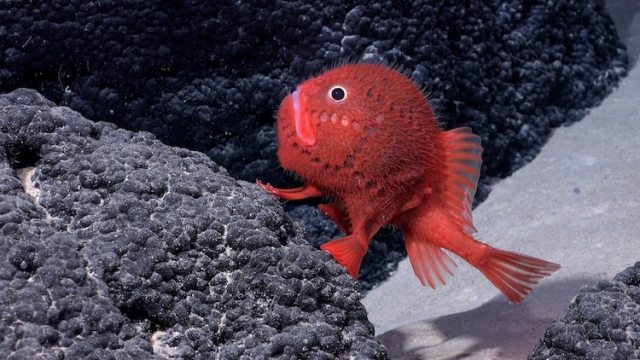 A Chaunacops (a genus of bony fish in the sea toad family Chaunacidae) is seen at a depth of 1388.65 meters on Seamount SF2 inside the Nazca-Desventuradas Marine Park. (Photo: Schmidt Ocean Institute, CC BY-NC-SA)
Only about 5% of our oceans have been explored. There’s a whole other world down there!
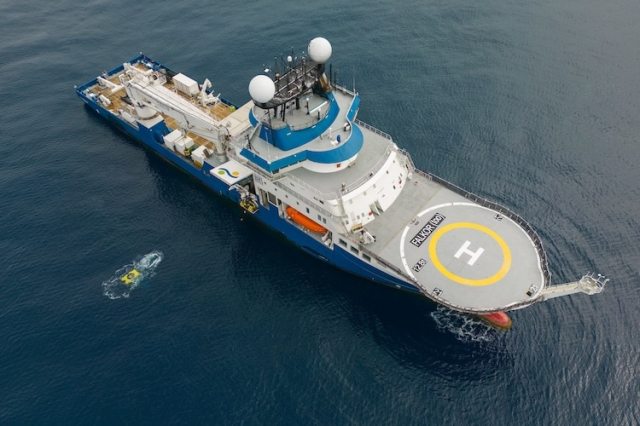 Remotely Operated Vehicle (ROV) SuBastain is deployed from Research Vessel Falkor (too) at the beginning of a scientific dive. (Photo: Alex Ingle / Schmidt Ocean Institute, CC BY-NC-SA)
In an era of widely accessible information and technological advances, it is easy to think scientists know everything there is to know about Earth. In reality though, the ocean is still a vast mystery. UNESCOestimates as little as 5% of it has been explored. This past January and February, scientists Dr. Javier Sellanes and Dr. Erin Easton led a team of international researchers, organized through the Schmidt Ocean Institute, to a remote region of the southeast Pacific. There they began to uncover strange new worlds thought to be unlike anywhere else. With the crucial help of an underwater robot, over a hundred new species have potentially been discovered.
 A spiraling coral documented at 1419 meters deep on Seamount JF1, within the bounds of the Mar de Juan Fernández Multiple Uses Marine Protected Area off the coast of central Chile. (Photo: ROV SuBastian / Schmidt Ocean Institute, CC BY-NC-SA)
The remotely operated vehicle ROV SuBastian, a robot that can dive to previously inaccessible depths of 14,000 feet, facilitated the crew of the Falkor (too) finding many diverse species in underwater mountain ranges, better known as ridges, off the coast of Chile. The Salas y Gómez, Nazca, and Juan Fernandez ridges are home to over 200 seamounts, or individual mountains, created by volcanic activity. Each seamount provides shelter to an underwater community that seems otherworldly, with long-living, slow-growing, and slow to reproduce species found nowhere else. These species are especially vulnerable to damage from human and oceanic forces.
Among specimens collected during the expedition, the team believes they have discovered new species of squat lobsters, which have arms longer than their bodies, and cactus-like sea urchins. They have also found vertebrates such as the Chaunacops fish, known as coffinfish. The coffinfish survives very deep underwater only by remaining motionless on the seafloor for the majority of its life.
While the images of brilliantly colored and alien-like sea life are mesmerizing in themselves, the data collected by the expedition will serve a critical purpose in conservation efforts.
In 2016, Chile banned bottom trawling on seamounts in its jurisdiction, but most of the ocean is outside of any one nation’s borders.[…]
More: Underwater Robot Discovers More Than 100 New Species in Chile

 msamba