
By Madeleine Muzdakis on April 28, 2024
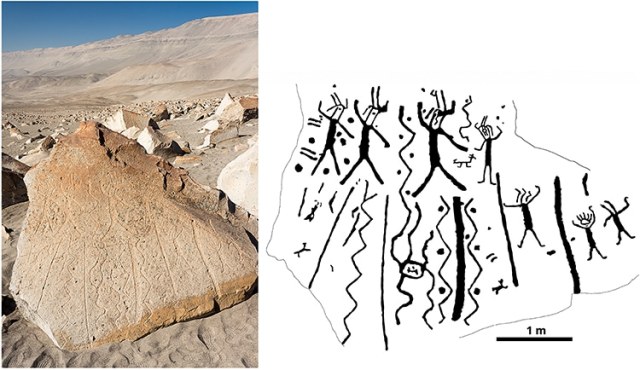 Photo: A. Rozwadowski; drawing: Polish-Peruvian research team (CC BY 4.0 DEED)
Music and dance have long been part of human culture and this ancient art may be rock hard proof.
Rock art always presents fascinating—sometimes mysterious—insight into the lives of ancient humans. What did they value enough to carve into stone? What do the patterns and designs mean? Some things, such as paintings or etchings of game and hunters, tell a clearer story. Others may raise questions with more ephemeral implications. Feelings, magic, and music might all lurk behind the engravings of prehistoric hands. In the Peruvian desert, a large collection of pre-Columbian rock art engravings at Toro Muerto depicts repetitive, dancing human figures. Surrounding them are countless zig-zags and squiggles. A new paper suggests these are petroglyphic representations of music played at psychedelic religious ceremonies.
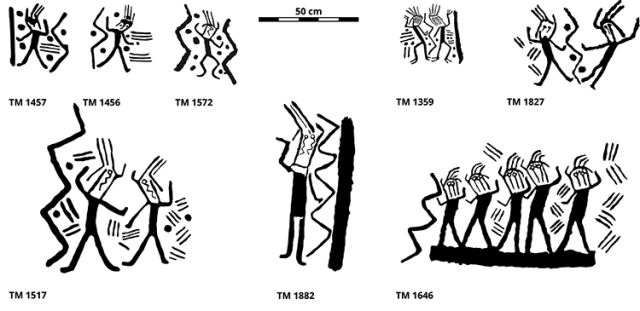 Photo: Polish-Peruvian research team, compiled by J.Z. Wołoszyn (CC BY 4.0 DEED)
The desert region of Toro Muerto contains thousands of petroglyphs carved into the rock by ancient artists. Dancers, danzantes, appear often. Surrounding them are lightning-like lines as well as dots and hash marks. Researchers have long wondered what these might be: lightning, water, or something else. The new paper suggests that the lines might, in fact, represent music and sound pulsing through the air. The researchers compared this to the art of the Tukano culture in the Colombian rainforest. In that culture’s artwork, geometric designs are thought to represent the psychedelic state felt during the sacred use of ayahuasca.
Songs in this culture were a way to transport oneself to the beginning of time.[…]
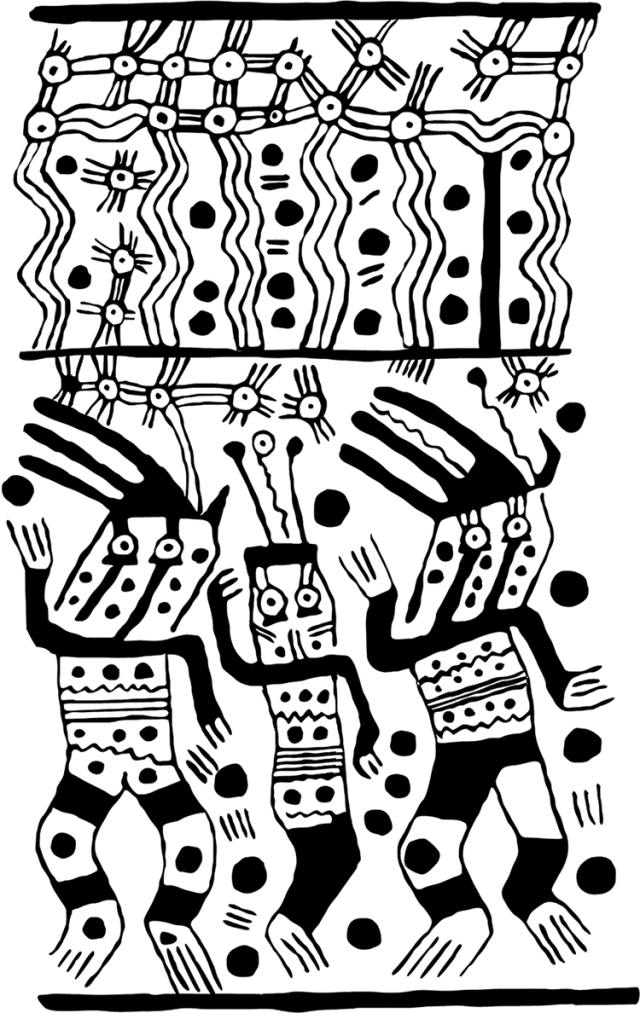 Photo: J.Z. Wołoszyn (CC BY 4.0 DEED)
Moree: Ancient Rock Art Depicts Psychedelic Music and Dance in Peru

 msamba