
November 19, 2024
Nature
Photography
Science
Kate Mothes

Dr. Kathryn Cooper uses a 19th-century photographic technique called chronophotography to reveal the complexities of starling murmurations.
Flocks of starlings share risk as hundreds—even thousands—of eyes are on the lookout for predators. “Remarkably, the group achieves this without any leadership structure, the simple interactions between individuals creating outcomes greater than the sum of their parts,” says scientist and photographer Dr. Kathryn Cooper.

Cooper’s professional background in physics and bioinformatics—a data science applied to biological systems—led her to study of the dynamics of networks. She uses a 19th-century photographic technique called chronophotography to reveal what she describes as “the robustness of self-organised systems in nature.”
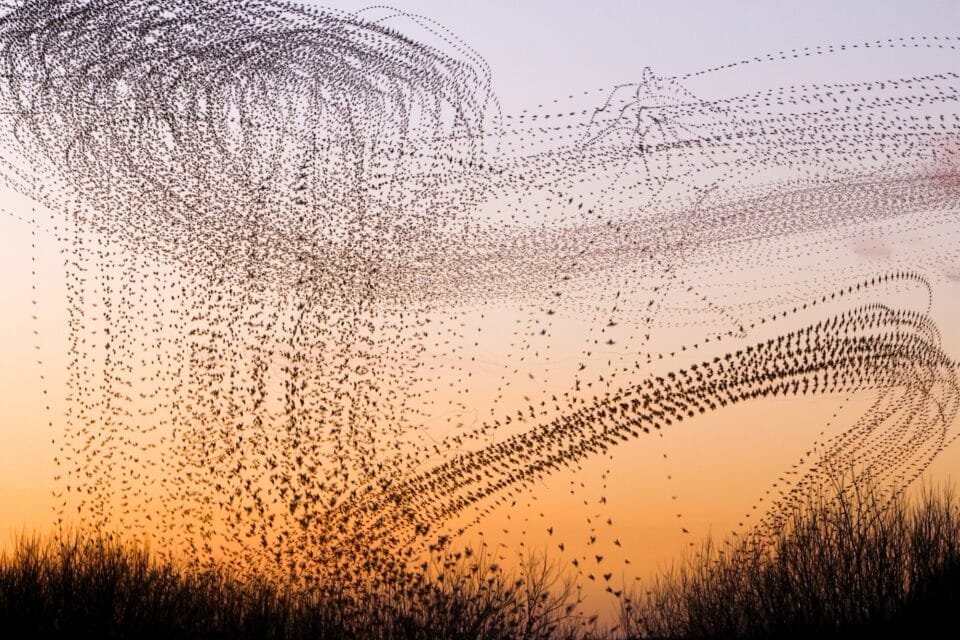
Some of the earliest motion studies during the Victorian era employed chronophotography. Cooper’s remarkable panoramas of starling murmurations contain numerous individual photos that, when superimposed into a single image, display the incredible flight paths and coordination of the group.
Just before dusk, smaller groups from the same area gather together above a communal roosting site. As the flock grows larger, they cast about the sky in an undulating murmuration.
A few basic principles govern the group’s rhythmic complexity, namely that each bird responds only to those closest to it. “This means that when one bird turns to avoid attack from a falcon, the birds around it also turn,” Cooper says. The neighboring birds turn a split second later, then their neighbors turn, and so on, which sends “a wave of information through the flock,” she adds. […]

More: Kathryn Cooper’s Layered Photos Capture the Complexities of Starling Murmurations

 msamba