
By Eva Baron on December 27, 2024
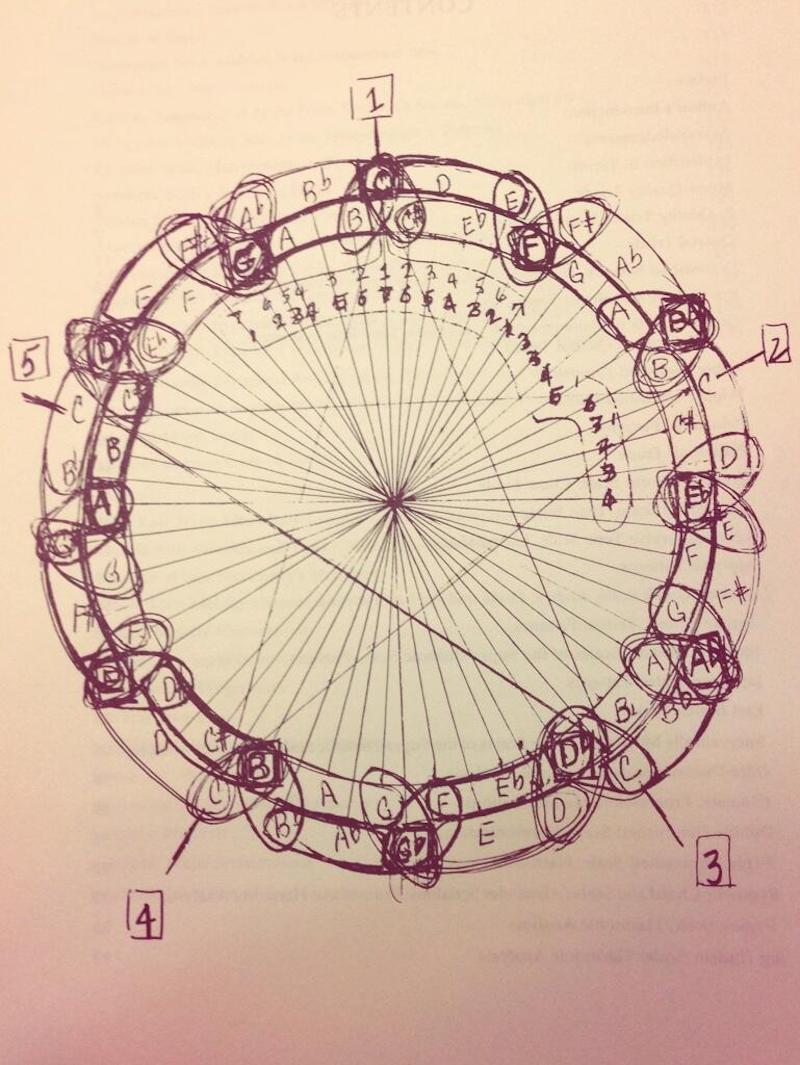 John Coltrane’s reinterpretation of the circle of fifths. The diagram is now known as “The Coltrane Circle” or “Coltrane’s Circle of Tones.”
Pythagoras once claimed that “there is geometry in the humming of the strings, and there is music in the spacing of the spheres.” The accomplished jazz saxophonist, bandleader, and composer John Coltrane thought similarly.
In 1967, Coltrane presented a geometric drawing to fellow saxophonist and professor Yusef Lateef. The drawing seemed to resemble a clock, featuring a circular pattern that connected musical notes with neatly spaced lines. The diagram would come to be known as “The Coltrane Circle” or “Coltrane’s Circle of Tones.”
 Portrait of John Coltrane, October 1963. (Photo: Hugo van Gelderen, via Wikimedia Commons)
The Coltrane Circle offers a compelling visualization of how mathematics and music interact, and has inspired countless essays on musical geometry. Based on the circle of fifths, Coltrane’s interpretation depicts the 12 semitones of the chromatic scale, mapping their notations, relative shades, and relationships to one another. Though portraying a recognizable principle in music theory, the drawing is unique in how it presents this information.
Most likely designed during in-depth studies of Albert Einstein’s work as well as Indian music, the Coltrane Circle retains an almost mystical composition despite its theoretical underpinnings. The lines that cut through the drawing’s interconnected circles create a star pattern in the center, beautifully merging art and music theory. For clarinetist Arun Ghosh, Coltrane’s Circle embodied a “musical system connected with the Divine.” Ghosh even commented that it “feels quite Islamic to me.”
The drawing, however, also reveals Coltrane’s preoccupation with physics and science. In his book The Jazz of Physics, physicist and saxophonist Stephon Alexander maintained that Coltrane was guided by the “same geometric principle that motivated Einstein’s” quantum theory. Coltrane was also known to discuss Einstein’s work frequently, to the extent that he mentioned to musician David Amram that he was “trying to do something like that in music.” […]
Source: Illustration Beautifully Visualizes Connections Between Math & Music

 msamba