
Joseph Howlett
Contributing Writer
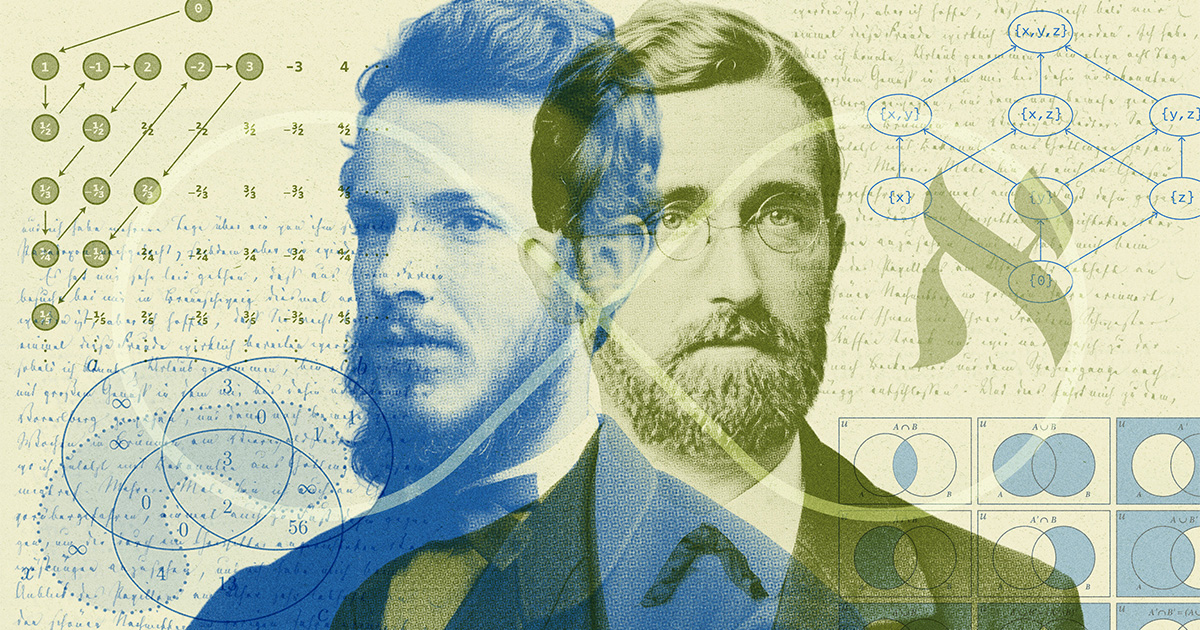 Kristina Armitage, Michael Kanyongolo/Quanta Magazine
When Demian Goos followed Karin Richter into her office on March 12 of last year, the first thing he noticed was the bust. It sat atop a tall pedestal in the corner of the room, depicting a bald, elderly gentleman with a stoic countenance. Goos saw no trace of the anxious, lonely man who had obsessed him for over a year.
Instead, this was Georg Cantor as history saw him. An intellectual giant: steadfast, strong-willed, determined to bring about a mathematical revolution over the clamorous objections of his peers.
It was here, at the University of Halle in Germany, that Cantor launched his revolution 150 years ago. Here, in 1874, he published one of the most important papers in math’s 4,000-year history. That paper crystallized a concept that had long been viewed as a mathematical malignancy to be shunned at all costs: infinity. It forced mathematicians to question some of their longest-held assumptions, rocking mathematics to its very foundations. And it gave rise to a new field of study that would eventually bring about a rewriting of the entire subject.
Now Goos, a 35-year-old mathematician and journalist, had come to Halle — a five-hour train ride from his home in Mainz — to look at some letters from Cantor’s estate. He’d seen a scan of one and was pretty sure he knew what the others would say. But he wanted to see them in person.
Richter — who, like Cantor, had spent her entire career here, first as a research mathematician and then, after retiring, as a lecturer on the history of mathematics — gestured for Goos to sit. She lifted a thin blue binder from the scattered piles of books and papers on her desk. Inside were dozens of plastic sheet protectors, each one containing an old, handwritten letter.
Goos began flipping through, contemplating the letters with the relish of an archaeologist entering a long-lost tomb. Then he reached a particular page and froze. He struggled to catch his breath.
It wasn’t the handwriting. At this point in his research on Cantor, he’d become accustomed to the strange, nearly indecipherable Gothic script known as kurrentschrift, which Germans used until around 1900.
It wasn’t the signature. He knew that the German mathematician Richard Dedekind had been a key player in Cantor’s quest to understand infinity and solidify math’s foundations, and that the two had exchanged many letters.
It was the date: November 30, 1873.
He’d never seen this letter before. No one had. It was believed to be lost, destroyed in the tumult of World War II or perhaps by Cantor himself.
This was the letter that had the power to rewrite Cantor’s legacy. The letter that proved once and for all that Cantor’s famous 1874 paper, the one that would go on to reshape all of mathematics, had been an act of plagiarism. […]
More: https://www.quantamagazine.org/the-man-who-stole-infinity-20260225/

 msamba