
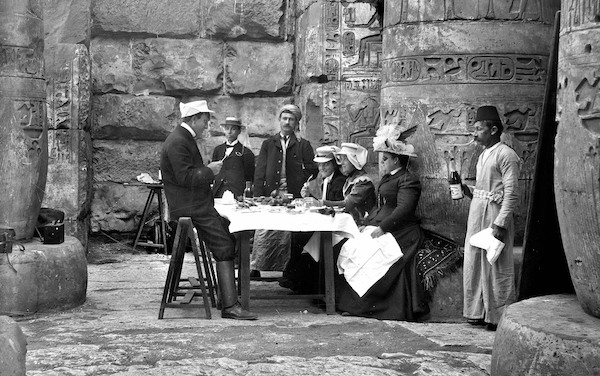
European tourists having a picnic in a temple in Egypt, 1898. Photo by LL/Roger Viollet/Getty Images
Mosul’s old city lies in ruins. A major section of the third largest city in Iraq has been destroyed by war. Two years after the Iraqi government and the United States-led coalition recaptured it from ISIS, the city is still noticeably scarred. Many residents have fled, or are detained in camps elsewhere in the country. Those who have returned live amid the ruins of their old houses and their old lives. But what is being reconstructed is cultural heritage. UNESCO has worked with the Iraqi government to launch a campaign called ‘Revive the Spirit of Mosul’, focusing on a handful of historic monuments in the city. The United Arab Emirates has pledged $50 million to rebuild the 850-year-old al-Nuri mosque and its minaret, known as al-Hadba (or the hunchback), a symbol of the city.
What is most striking about this campaign is its seeming indifference to the lives of the people who call the city home. UNESCO’s promotional videopans through the old city; block after block after block lies completely devastated … only for the camera to abandon them for the one monument that will actually be rebuilt. What kind of reconstruction is this, and who benefits from it? Certainly not the residents. Many Iraqis suspect that the Shiite-led national government is exacting revenge on the Sunni-majority population of the city. Instead, it appears that the main beneficiaries are the governments gaining prestige by launching and funding this campaign.
Cases such as Mosul’s highlight a key fact about cultural heritage: it is not primarily about the past – as counterintuitive as that might be. It is about the present. Heritage harnesses the power of the past to justify present social relations, especially relations of power. Governments trample over the lives and needs of individuals and communities, the wealthy convert their dubiously acquired wealth into cultural capital, all in the name of that heritage. And in our conviction that we must protect the remains of the past, the rest of us are often swept up in the enthusiasm. We don’t even question the relatively new idea of cultural heritage – that the remains of history are to be unquestionably treasured as our inheritance from the past and must be preserved in their original state. Or that what typically counts as cultural heritage are major historic buildings and monuments, perfectly suited to be exploited as symbols of the powerful.
We have always been interested in the remains of the past. But our current way of thinking about heritage began to take shape in the 19th century. Europeans looked to preserve medieval buildings at home. And in the Middle East, interest in cultural heritage grew as monuments of the ancient past were threatened by modernisation and theft. Egypt in 1835 and the Ottoman Empire in 1869 instituted laws to protect monuments and artifacts from theft and destruction. But these laws were widely disregarded by Europeans and Americans. ‘Mehemet Ali, not satisfied with those [monopolies] he has established on the living, has lately introduced one also in the kingdom of the dead,’ was how the correspondent of the London Morning Post in Constantinople dismissed the law in 1835. Everyone from antiquities dealers to the Baedekers travel guides gave advice on how to illegally purchase looted antiquities in the Middle East, or to conduct your own illegal excavations, or to remove antiquities by bribing customs officials and police officers. E A Wallis Budge, the head of Egyptian antiquities at the British Museum, spoke openly of the elaborate ruses he had used to smuggled ancient papyri out of Egypt.
Such was the situation in the late 19th and early 20th centuries.[…]
Source: https://aeon.co/essays/why-cultural-heritage-benefits-the-rich-and-powerful-above-all

 msamba
For 50 million USD they could rebuild a lot of destroyed homes …
LikeLiked by 1 person
Yes but they won’t…
LikeLiked by 1 person
No, unfortunately. But these poor people … I mean they live in ruins, but the stupid monument gets rebuilt. It is like they get sneered at by these rich people, it just makes me sick.
LikeLike