
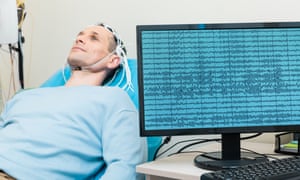
Study funded by Facebook aims to improve communication with paralysed patients
When Stephen Hawking wanted to speak, he chose letters and words from a synthesiser screen controlled by twitches of a muscle in his cheek.
But the painstaking process the cosmologist used might soon be bound for the dustbin. With a radical new approach, doctors have found a way to extract a person’s speech directly from their brain.
The breakthrough is the first to demonstrate how a person’s intention to say specific words can be gleaned from brain signals and turned into text fast enough to keep pace with natural conversation.
In its current form, the brain-reading software works only for stock sentences it has been trained on, but scientists believe it is a stepping stone towards a more powerful system that can decode in real time the words a person intends to say.
Doctors at the University of California in San Francisco took on the challenge in the hope of creating a product that allows paralysed people to communicate more fluidly than using existing devices that pick up eye movements and muscle twitches to control a virtual keyboard.
“To date there is no speech prosthetic system that allows users to have interactions on the rapid timescale of a human conversation,” said Edward Chang, a neurosurgeon and lead researcher on the study published in the journal Nature Communications.
The work, funded by Facebook, was possible thanks to three epilepsy patients who were about to have neurosurgery for their condition. Before their operations went ahead, all three had a small patch of tiny electrodes placed directly on the brain for at least a week to map the origins of their seizures.
During their stay in hospital, the patients, all of whom could speak normally, agreed to take part in Chang’s research. He used the electrodes to record brain activity while each patient was asked nine set questions and asked to read a list of 24 potential responses.[…]
Source: Neuroscientists decode brain speech signals into written text

 msamba
Wow. How wonderful and how dangerous. “I can read your mind.”
LikeLiked by 1 person
Brain-reading to help paralyzed people sounds great … but when I think of the possibilities for misuse and control, I shiver!
LikeLiked by 1 person