
 A new NASA study shows that over the last 20 years, the atmosphere above the Amazon rainforest has been drying out, increasing the demand for water and leaving ecosystems vulnerable to fires and drought. It also shows that this increase in dryness is primarily the result of human activities.
Scientists at NASA’s Jet Propulsion Laboratory in Pasadena, California, analyzed decades of ground and satellite data over the Amazon rainforest to track both how much moisture was in the atmosphere and how much moisture was needed to maintain the rainforest system.
“We observed that in the last two decades, there has been a significant increase in dryness in the atmosphere as well as in the atmospheric demand for water above the rainforest,” said JPL’s Armineh Barkhordarian, lead author of the study. “In comparing this trend to data from models that estimate climate variability over thousands of years, we determined that the change in atmospheric aridity is well beyond what would be expected from natural climate variability.”
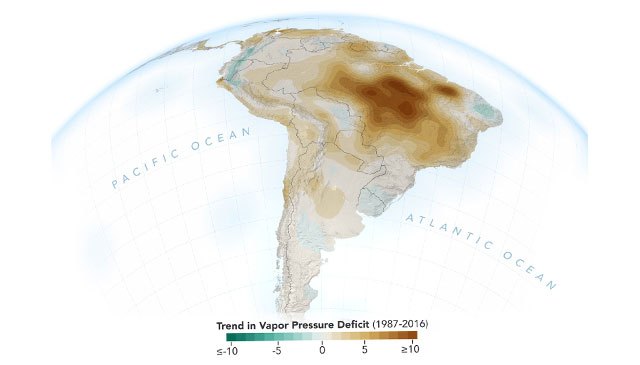
The image shows the decline of moisture in the air over the Amazon rainforest, particularly across the south and southeastern Amazon, during the dry season months – August through October – from 1987 to 2016. The measurements are shown in millibars. Credit: NASA/JPL-Caltech, NASA Earth Observatory
Larger view
So if it’s not natural, what’s causing it?
Barkhordarian said that elevated greenhouse gas levels are responsible for approximately half of the increased aridity. The rest is the result of ongoing human activity, most significantly, the burning of forests to clear land for agriculture and grazing. The combination of these activities is causing the Amazon’s climate to warm.[…]
Read More: Human Activities Are Drying Out the Amazon: NASA Study – ScienceBlog.com

 msamba
