
These ultra-black fish absorb light so efficiently that even in bright light they appear to be silhouetted.
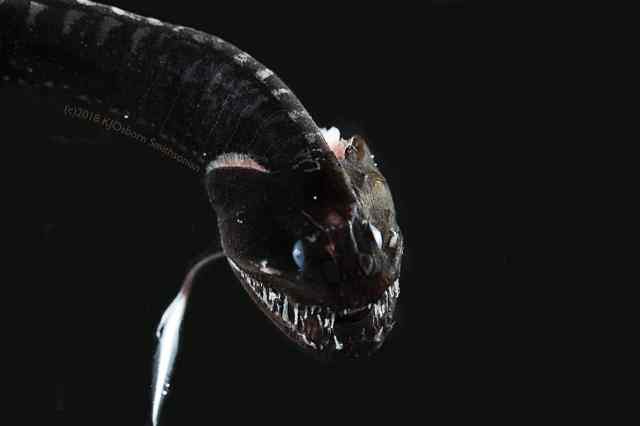
Smithsonian scientists and a team of collaborators have discovered the 16 new species of distantly related deep-sea fishes that barely reflect light that hits their skin, just like the ultra-black Vantablack material.
According to scientists, these ultra-black fish absorb light so efficiently that even in bright light, they appear to be silhouettes with no features noticeable to the human eye. In the darkness of the ocean, even surrounded by bioluminescent light, they literally disappear. Some of the newly discovered ultra-black fish species found in the deep sea are so dark that they absorbed more than 99.5% percent of the light that hit their surfaces.
The solar rays very effectively penetrate up to 20 m depth and do not go beyond 200 m oceanic depths. In that environment, bioluminescence from most deep-sea creatures is the only light source. Bioluminescent glows are used to attract mates, distract predators, lure prey, and expose nearby animals.
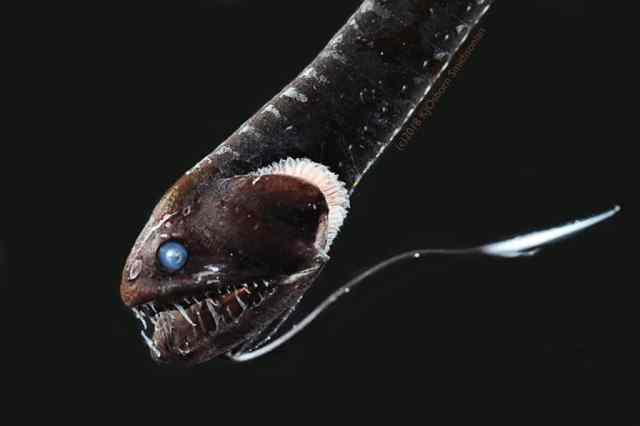
Karen Osborn, the co-author of the new study, first became interested in these fish skin when she tried to photograph some striking blackest fish. Despite sophisticated equipment, she said, she could not capture any detail in the images. “It didn’t matter how you set up the camera or lighting—they just sucked up all the light.”
As the new research shows, the near-complete light absorption of ultra-black fish depends on melanin, the same pigment that colors and protects human skin from sunlight. Experts discovered that this pigment is not only abundant in the skin of ultra-black fish but is arranged in a particularly special way. The pigment cells are made up of densely-packed compartments called melanosomes, which waste very little light thanks to their size, shape, and positioning. The arrangement of the melanosomes causes them to direct any light they do not immediately absorb toward neighboring melanosomes within the cell, which then suck up the remaining light.
“Effectively what they’ve done is make a super-efficient, super-thin light trap,” Osborn said. “Light doesn’t bounce back; Light doesn’t go through. It just goes into this layer, and it’s gone.”[…]
Continue reading: Scientists discover ultra-black fish that absorbs 99.5% of light that hits its skin

 msamba