
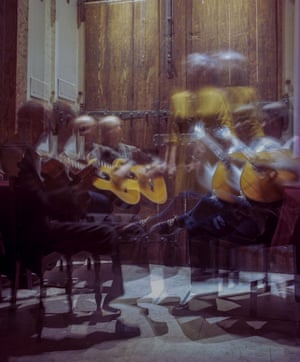
- Fado performance at Mesa de Frades in Alfama. On the left sits Joel Piña, the 99-year-old musician credited with introducing the acoustic bass to fado. As a long-time collaborator of Amália Rodrigues, he is considered a living legend in fado circles.
A portrait of Lisbon, saudade and the fado folk music of the city and its relationship with tourism. Henri Kisielewski is the 2019 recipient of the Joan Wakelin bursary, administrated in partnership with the Royal Photographic Society
Fado is Lisbon’s urban folk music, born in and around the brothels, alleyways and tascas of the city’s poorest neighbourhoods. Fado is to Lisbon what the Blues are to the Delta. Written records trace it back to the early 19th century, though some argue it is much older, connecting it to oral traditions imported from across the Portuguese empire.
At the heart of fado is saudade. This elusive word – apparently untranslatable from the original Portuguese – broadly refers to a sense of sorrow, of yearning, and a resigned desire for what once was. This is the underlying emotion of all fado and perhaps of Lisbon itself.
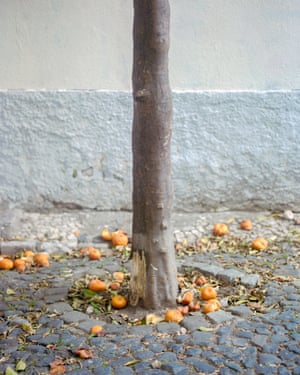
An orange tree in one of Alfama’s many cobbled alleyways.
Alfama is Lisbon’s oldest surviving neighbourhood: a maze of medieval and moorish architectures arranged in a patchwork of steep cobbled alleyways and red-clay roofs, rising up from the Tagus river. Once a close-knit fishing community, it is now the heart of Lisbon’s tourist industry.
A decade ago, struggling to recover from a deep recession, Portugal’s government turned to tourism and opened the real-estate market to foreign speculation. Today, more then half of all accommodation in Alfama is destined for tourism and thousands of long-standing residents have been priced out of the city centre. One after another, the shops that catered to the local community closed to make way for tourist-facing businesses – many of which are “fado restaurants” – and now Alfama feels more like a theme park than a living neighbourhood. This touristification is affecting much of the city. If things keep going the way they are, one journalist wrote in 2016, Lisbon will soon have to hire extras to play Portuguese people in its streets.[…]

 msamba
That seems to be the fate of many beautiful old places. I had this theme park feeling in Bruges.
LikeLike
: 3 (
LikeLike