
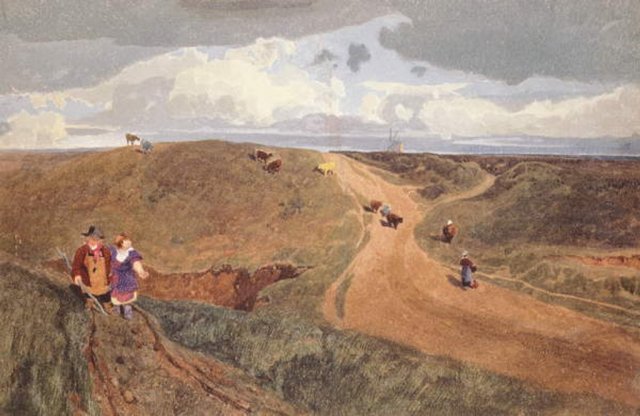
 Mousehold Heath (1810) by John Sell Cotman. Drawing on paper. According to the UK Government, between 1604 and 1914 enclosure Bills enacted by Parliament restricted access to formerly open communal land comprising just over a fifth of the total area of England. Courtesy the Trustees of the British Museum
4,500 words
Edited by Sam Haselby
I’ve witnessed massive swarms of fireflies
grace my garden like never before, drawn
to the air cleansed of our arrogant greed,
their glow a flashback to the time before
us, omen of Earth without us, a reminder
we’re never immune to nature. I say this
might be the end we’ve always needed
to begin again …
– From the poem ‘Say This Isn’t the End’ (2020) by Richard Blanco
A basic truth is once again trying to break through the agony of worldwide pandemic and the enduring inhumanity of racist oppression. Healthcare workers risking their lives for others, mutual aid networks empowering neighbourhoods, farmers delivering food to quarantined customers, mothers forming lines to protect youth from police violence: we’re in this life together. We – young and old, citizen and immigrant – do best when we collaborate. Indeed, our only way to survive is to have each other’s back while safeguarding the resilience and diversity of this planet we call home.
As an insight, it’s not new, or surprising. Anthropologists have long told us that, as a species neither particularly strong nor fast, humans survived because of our unique ability to create and cooperate. ‘All our thriving is mutual’ is how the Indigenous scholar Edgar Villanueva captured the age-old wisdom in his book Decolonizing Wealth (2018). What is new is the extent to which so many civic and corporate leaders – sometimes entire cultures – have lost sight of our most precious collective quality.
This loss is rooted, in large part, in the tragedy of the private – this notion that moved, in short order, from curious idea to ideology to global economic system. It claimed selfishness, greed and private property as the real seeds of progress. Indeed, the mistaken concept many readers have likely heard under the name ‘the tragedy of the commons’ has its origins in the sophomoric assumption that private interest is the naturally predominant guide for human action. The real tragedy, however, lies not in the commons, but in the private. It is the private that produces violence, destruction and exclusion. Standing on its head thousands of years of cultural wisdom, the idea of the private variously separates, exploits and exhausts those living under its cold operating logic.
In preindustrial societies, cooperation represented naked necessity for survival. Yet the realisation that a healthy whole is larger than its parts never stopped informing cultures. It embodies the pillars of Christianity as much as the Islamic Golden Age, the Enlightenment or the New Deal. In the midst of a global depression, the US president Franklin D Roosevelt evoked an ‘industrial covenant’ – a commitment to living wages and a right to work for all. During the 1960s, Martin Luther King, Jr gave voice to the broader idea when he said that no one is free until we are all free. On Earth Day 1970, the US senator Edmund Muskie proclaimed that the only society to survive is one that ‘will not tolerate slums for some and decent houses for others, … clean air for some and filth for others’. We should call these ideas what they are – central civilisational insights. Social and economic prosperity depends on the wellbeing of all, not just the few.
Cultures that fundamentally departed from this awareness usually did not, in the long run, fare well, from the Roman Empire to Nazism or Stalinism. Will neoliberal capitalism be next? Rather than acknowledge the endless variety of things that had to be in place to make our individual accomplishments possible, it is grounded in the immature claim that our privileges are ‘earned’, made possible primarily by private initiative.
But what a claim it is: where would we be without the work and care of others? Without the food from the farmer? Without the electricity and housing and roads and healthcare and education and access to information and hundreds of other things provided to us, day in and day out, often for free, and routinely without us knowing what went into their existence? Seeing ourselves as seemingly free-floating individuals, it’s both easy and convenient to indulge in the delusion that ‘I built it. I worked for it. I earned it.’
The painful flipside are the billions of those who, through no fault of their own, drew the short end of the stick. Those who were born in the wrong country, to the wrong parents, in the wrong school district – ‘wrong’ for no other reason than that their skin colour or religion or talents didn’t happen to be favoured. The limited focus on the individual can here be seen as nakedly serving power: if those who have privilege and wealth presumably earned it, so must those who have pain and hardship deserve it.[…]
Continue reading:https://aeon.co/essays/the-challenge-of-reclaiming-the-commons-from-capitalism

 msamba