
Equalling Michael Schumacher’s seven titles will underline that the British driver is perhaps his sport’s last great champion – but his world is a bigger place than the paddock
Colour has always mattered in Formula One. Bugattis were blue, Ferraris are red, Mercedes are silver – that kind of thing. But in 2020 Lewis Hamilton brought a different awareness of what colour can mean to a sport whose emphasis on technological progress has always been accompanied by a deep cultural conservatism.
In a year when he was aiming to make history by surpassing Michael Schumacher’s all-time record of 91 grand prix wins and matching the same driver’s total of seven world championships, Hamilton could have been forgiven for keeping his head down and concentrating wholly on his work in the cockpit. And indeed this season has shown us all the dimensions of his greatness – overcoming a disintegrating tyre to win at Silverstone, untouchably imperious at Spa, using all his racecraft to prevail at Portimão – as well as exhibiting the occasional flaw that makes him human.
But his world is a bigger place than the Formula One paddock, his preoccupations larger than its imperatives. When Hamilton asked his 19 fellow drivers to emulate the American footballer Colin Kaepernick by taking a knee for the first time at the Austrian Grand Prix in June, he was challenging the ingrained behaviour of a sport that has spent more than a century resolutely steering clear of any hint of political engagement. Until 2020, Formula One had no equivalents of Tommie Smith and John Carlos, sporting figures willing to risk taking a stand against injustice. Instead, grands prix were often held in countries where human rights were not high on the governmental priorities. The sport went where the money was, washing its hands of moral considerations.
Exceptions were rare. When Stirling Moss competed in South Africa in 1959, at the height of the apartheid era, he suggested to his fellow drivers that they should wave at the end of the race only to spectators in the enclosures to which non-whites had been restricted. But that, until 2020, was about the extent of motor racing’s active involvement in political protest. The jailing of activists in Bahrain or the repression of ethno-religious minorities in China were none of its concern.
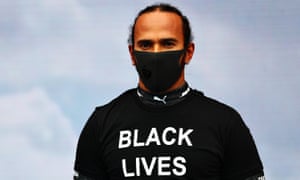
Hamilton burst that bubble. The most successful driver in the sport, the most visible and well known around the world (and the earner of its highest salary, up to £40m including bonuses), he raised his head above the parapet. Not only did he wear a Black Lives Matter T-shirt, he persuaded his team to support his stand in the most explicit and distinctive of ways – and, to some traditionalists, the most shocking – by changing the colour of their cars.[…]
Continue reading: Lewis Hamilton: the man from Stevenage who became the moral compass of F1

 msamba