
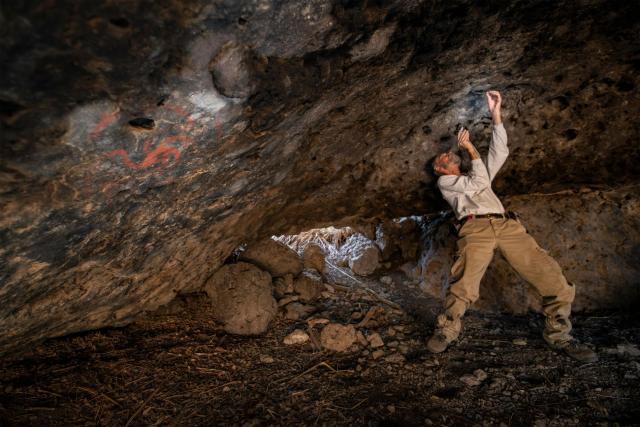
 Research team member Jon Picciuolo documents quids (wads of chewed-up plant matter) that were stuffed centuries ago into crevasses in the walls of Pinwheel Cave in southern California. The painted pinwheel that gives the cave its name can be seen to the left.
PHOTOGRAPH BY DEVLIN GANDY
People at California’s Pinwheel Cave left evidence of their altered state literally stuffed into its walls—the first physical evidence for hallucinogenic consumption at a rock art site.
RESEARCHERS HAVE DEBATED for decades over the relationship between hallucinogens and rock art. Ancient cultures around the world have left an intriguing legacy of abstract, even psychedelic-looking images on cliff faces and cave walls, but modern researchers argue over the motivation behind the creation of such artworks.
Until now there has been no physical evidence of the use of hallucinogens at rock art sites. But a surprising discovery at a site in southern California now provides proof that at least some people experienced the site in an altered state of consciousness centuries ago.
In a study published today in Proceedings of the National Academy of Sciences, an international research team reports that 400-year-old chewed-up wads of datura, a plant with powerful psychoactive properties, have been found stuffed into the cracks of the ceiling of a sacred cave. Located near the edge of the traditional territory of the Chumash people, the cavern had been dubbed Pinwheel Cave after the swirling red painting on its curved ceiling. Researchers think this artwork might represent a datura flower, which unfurls in a pinwheel shape at dusk, and that the site may have been a place for group ceremonies where datura was consumed.“This is the first evidence of the ingestion of a hallucinogen at a rock art site—the evidence is literally on the wall,” says Carolyn Boyd, an archaeologist at Texas State University, who wasn’t involved in the new research but specializes in Native American rock art.
Sacred and dangerous
Pinwheel Cave is one of several rock art sites in the Wind Wolves Preserve, which encompasses 93,000 acres to the south of Bakersfield and is owned by The Wildlands Conservancy, a nonprofit founded in 1995. Inside the cave are a few abstract red blobs and smears; the pinwheel painting, which was first recorded by archaeologists in 2002, is the most distinct artwork. The image is located on a sloping section of the low ceiling, about three feet off the ground. During summer solstice, a beam of sunlight travels across it.
Archaeologist David Robinson, leader of the new study, had been researching and documenting rock art in California for two decades; he and his colleagues started working at Pinwheel Cave in 2007. Through small excavations and radiocarbon dating, they found that the site had been occupied from around A.D. 1530 to 1890. The archaeologists discovered that more than 50 little crevices in the ceiling were stuffed with wads of chewed plant fibers, called quids. Chewed to extract nutrition, usually from plants like yucca and agave, quids are a common find in archaeological sites in the southwestern U.S.
The researchers initially took a sample of quids, hoping to find traces of ancient human DNA. While those analyses failed to turn up useful genetic evidence, subsequent tests on 15 quids showed that they contained scopolamine and atropine, hallucinogenic alkaloids found in datura. Microscopic images captured with a scanning electron microscope confirmed that most of the quids contained plant matter of the species Datura wrightii. Subsequent 3D analyses of the quids showed that these fibers had been gnashed and broken in patterns consistent with chewing.
Deadly in high doses, with potency that’s often difficult to predict, datura is very dangerous. But the plant can also be classified as an entheogen, or a psychoactive substance that’s used for spiritual purposes, in the same category as ayahuasca and peyote. In the cosmology of the Chumash people, who historically consumed the plant during initiation ceremonies and shamanic vision quests, datura was in a special category of plants seen as kin; it was personified as an old woman named Momoy, says Robinson.[…]
Continue reading: 400 years ago, visitors to this painted cave took hallucinogens

 msamba