
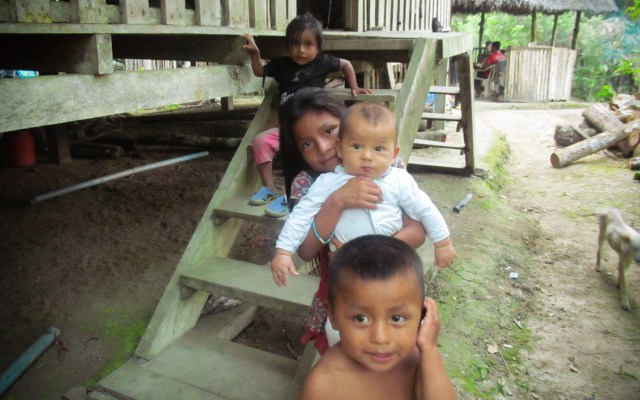
 All photos courtesy and © the author
In the eyes of the Runa people, Western kids grow up indulged, over-mothered and incapable of facing outward to the world
Imata raun paiga? (‘What is she doing?’) – my husband’s grandmother, Digna, asks him. The ‘she’ Digna is referring to is me. What I am doing is rather simple: I am wrapping my four-month-old son in a baby sling, his face toward my chest, in a calm, reassuring embrace. But my husband’s grandmother, who has raised 12 children in a small village in the Ecuadorian Amazon, does not think of this mundane gesture as being anything normal.
‘Why is she wrapping the baby like that?’ she insists, with genuine surprise. ‘This way the baby is trapped! How is he even able to see around?’ Squished inside the wrap, my son immediately starts crying, as if confirming his great-grandmother’s opinion. I bounce him up and down, in the hope of soothing his cries. I turn to Digna and say: ‘This way he is not overstimulated, he sleeps better.’ Digna, who has since passed away, is a wise, dignified woman. She simply smiles and nods, saying: ‘I see.’ I keep bouncing up and down, walking back and forth across the thatched house, until my son eventually snoozes and I can breathe again.
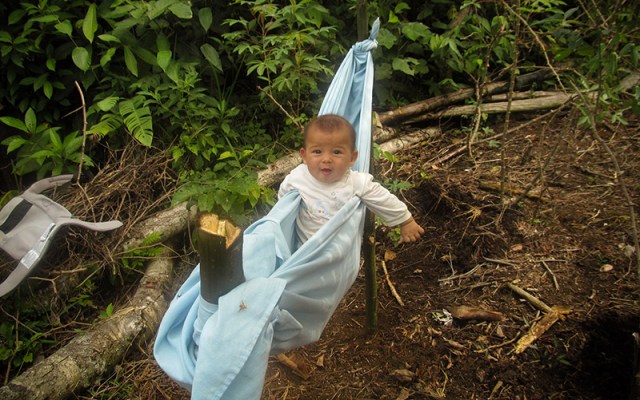
The relief of being able to breathe again: that’s perhaps a feeling familiar to most new parents. Like many other people I know, I also almost lost my mind after the birth of my first child. It’s hard to tell how the madness began: whether it started with the kind and persistent breastfeeding advice of the midwives at the baby-friendly hospital where I gave birth, or with a torn copy of Penelope Leach’s parenting bestseller, Your Baby and Child: From Birth to Age Five, first published in 1977, confidently handed to me by a friend who assured me it contained all I needed to know about childcare. Or maybe it was just in the air, everywhere around me, around us: the daunting feeling that the way I behaved – even my smallest, most mundane gestures – would have far-reaching consequences for my child’s future psychological wellbeing. I was certainly not the only parent to feel this way.
Contemporary parenting in postindustrial societies is characterised by the idea that early childhood experiences are key to successful cognitive and emotional development. The idea of parental influence is nothing new and, at a first glance, it seems rather banal: who wouldn’t agree, after all, that parents have some sort of influence over their children’s development? However, contemporary parenting (call it what you like: responsive parenting, natural parenting, attachment parenting) goes beyond this simple claim: it suggests that caretakers’ actions have an enormous, long-lasting influence on a child’s emotional and cognitive development. Everything you do – how much you talk to your children, how you feed them, the way you discipline them, even how you put them to bed – is said to have ramifications for their future wellbeing.
This sense of determinism feeds the idea of providing the child with a very specific type of care. As a document on childcare from the World Health Organization (WHO) puts it, parents are supposed to be attentive, proactive, positive and empathetic. Another WHO document lists specific behaviours to adopt: early physical contact between the baby and the mother, repeated eye contact, constant physical closeness, immediate responsiveness to infant’s crying, and more. As the child grows older, the practices change (think of parent-child play, stimulating language skills), yet the core idea remains the same: your child’s physical and emotional needs must be promptly and appropriately responded to, if she is to have an optimal development and a happy, successful life.
Like other such parents, in the first few postpartum months I also engaged, rather unreflectively, in this craze. However, when my son was four months old, during a period ridden with chaos, parental anxiety, sleep deprivation and mental fogginess, my husband and I made the decision to leave Europe. We packed our clothes and a few other things and hopped on a flight to Ecuador. Our final destination: a small Runa Indigenous village of about 500 people in the Ecuadorian Amazon. Our decision wasn’t as mad as it sounds. The Ecuadorian Amazon is where my husband grew up and where his family currently lives. It is also the place where I have been doing research for more than a decade. We wanted to introduce our newborn to our family and friends in the village, and we didn’t think twice before going. I could not yet imagine the repercussions this decision would have on me, both as a mother and as a scholar.
I ended up in frantic searches across the village to find my baby, under the perplexed stares of neighbours
In the first weeks of our stay in my husband’s village, family and neighbours quietly observed how I took care of my son. He was never out of my sight, I was there always for him, promptly responding to (and anticipating) any of his needs. If he wanted to be held or breastfed, I would interrupt any activity to care for him. If he cried in the hammock, I quickly ran to soothe his cries. Our closeness soon became the subject of humour, and then, as the months passed, of growing concern. Nobody ever said anything explicitly to me or my husband. Most Runa Indigenous people – the community to which my husband belongs – are deeply humble and profoundly dislike to tell others how to behave. Yet it became clear that my family and neighbours found my behaviour bizarre, if not at times utterly disconcerting. I did not really understand their surprise nor did I, in the beginning, give it too much thought.

People, however, started rebelling. They did so quietly, without making a fuss, but consistently enough for me to realise that something was going on.[…]
Continue reading: Why Runa Indigenous people find ‘natural parenting’ so strange | Aeon Essays
Francesca Mezzenzana is an anthropologist working with the Runa of the Ecuadorian Amazon. She has a PhD in anthropology from the London School of Economics, and is the principal investigator of the LearningNatures project, based at the Rachel Carson Center for Environment and Society in Munich, Germany.

 msamba
A very interesting article. The Runa way sounds a bit like the way Italians treat their children, or at least did in the past, taking them absolutely everywhere with them, always being in a large group of people.
It seems to me that it is better for a child as well. Do you remember the movie “About a boy”, where this boy living alone with his mother is starting to collect “backups”? He knew that it wasn’t good to only have one close contact.
LikeLiked by 1 person